
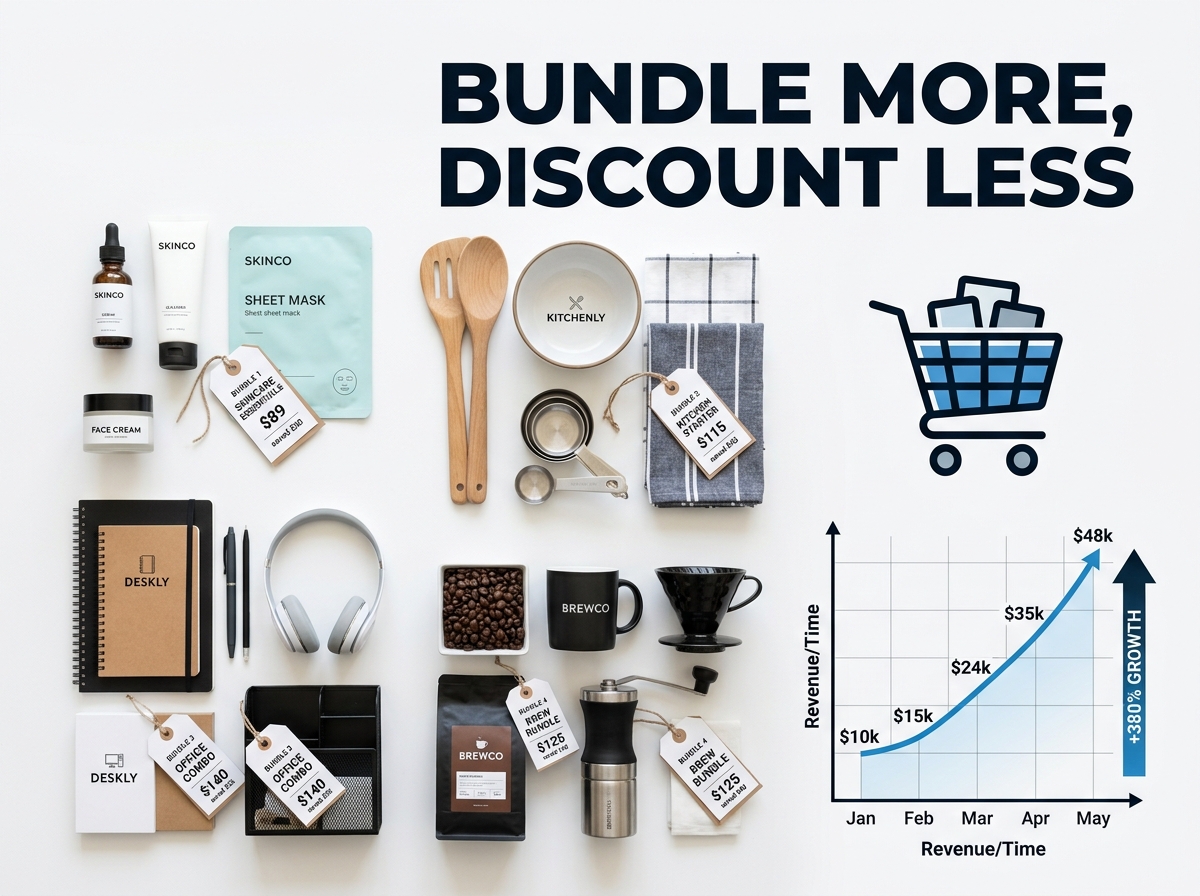
If you’re running an online store, you’ve probably heard the advice to “increase your average order value.” But most of the tactics out there involve discounting — and discounting eats into your margins fast. That’s where a smart product bundling strategy ecommerce owners can actually use comes in. Bundling lets you sell more per transaction without training your customers to wait for a sale. In this post, we’ll break down exactly how to do it.
What Is Product Bundling and Why Does It Work?
Product bundling is the practice of grouping two or more products together and selling them as a single package. Think of it like a curated shopping experience — you’re doing the decision-making for your customer and making it easy for them to say yes to more.
The psychology behind bundling is powerful. When customers see a bundle, they perceive higher value even if the price isn’t dramatically lower. It reduces decision fatigue, increases perceived convenience, and often feels like a gift to themselves. That’s a win for your customer and your bottom line.
The Difference Between Bundling and Discounting
Here’s the key distinction: discounting reduces the price of what you already sell, while bundling increases the total value of what a customer buys. A 20% off sale might bring someone in, but a well-crafted bundle encourages them to spend more than they originally planned — without feeling like they’re overpaying.
Done right, bundling can actually protect your pricing integrity. You’re not slashing prices; you’re adding value. That’s a completely different message to your market.
Types of Product Bundles That Work for Ecommerce
Not all bundles are created equal. The type of bundle you choose should match your product catalog, your customer behavior, and your business goals. Here are the most effective formats to consider.
Pure Bundles
A pure bundle means the products are only available as a set — they can’t be purchased individually. This works well when the products are naturally complementary and don’t make as much sense on their own. Think of a skincare starter kit where each step in the routine is included.
Mixed Bundles
Mixed bundles offer products both individually and as a package. This is the most flexible option and works for most ecommerce stores. You give customers the choice, but you make the bundle feel like the smarter, more complete option.
Cross-Sell Bundles
Cross-sell bundles pair a primary product with complementary add-ons. If someone is buying a camera, you bundle it with a memory card and a carrying case. This is one of the most natural and effective bundling approaches because it mirrors how customers already think about their purchases.
Build-Your-Own Bundles
This format lets customers choose from a selection of products to create their own bundle, often at a slight incentive. It’s highly engaging and works especially well for food, beauty, and lifestyle brands. Customers feel in control, which increases satisfaction and reduces returns.
How to Build a Product Bundling Strategy That Actually Increases Revenue
Knowing the types of bundles is one thing — building a strategy around them is another. Here’s how to approach your product bundling strategy ecommerce implementation in a way that drives real results.
Start With Your Data
Look at your order history and identify which products are frequently purchased together. Your analytics are telling you what your customers already want — you just need to listen. Tools like Google Analytics, Shopify reports, or your CRM can surface these patterns quickly.
Also look at your highest-margin products. Bundling a high-margin item with a lower-margin one can actually improve your overall profitability per order, even if the bundle price feels like a deal to the customer.
Price Bundles Strategically
You don’t have to discount to make a bundle feel valuable. Instead, focus on perceived value. Show the individual prices alongside the bundle price so customers can see what they’re getting. Even a modest saving of 10–15% can be enough to tip the decision — and you’re still coming out ahead on volume.
Another approach is to keep the price the same but add a bonus item. “Buy these two products and get a travel-size version free” feels generous without cutting into your core pricing.
Position Bundles at the Right Moment
Timing matters. The best places to present bundles include:
- Product pages — show a “frequently bought together” section
- Cart page — suggest a bundle upgrade before checkout
- Post-purchase emails — introduce a bundle for their next order
- Landing pages — build dedicated pages around seasonal or themed bundles
If you’re using Shopify or WooCommerce, there are plugins that make this easy to automate. And if you want to take it further, Make.com automation can trigger bundle offers based on customer behavior, cart value, or purchase history — without any manual work on your end.
Test and Refine Your Bundles
Your first bundle won’t be your best one. Run A/B tests on bundle composition, pricing, and placement. Track your average order value before and after introducing bundles, and pay attention to which combinations convert best. This is an ongoing process, not a one-time setup.
Need help setting up tracking and testing for your store? Check out our guide on ecommerce SEO and conversion optimization to make sure your store is built to capture every opportunity.
Common Mistakes to Avoid With Product Bundling
Even a solid product bundling strategy ecommerce can fall flat if you make a few common missteps. Here’s what to watch out for:
- Bundling random products together — if the items don’t make sense as a set, customers won’t see the value
- Overcomplicating the offer — keep it simple; too many options cause decision paralysis
- Ignoring inventory — make sure you can fulfill bundles consistently before promoting them heavily
- Forgetting to promote the bundle — a great bundle that no one sees won’t move the needle
- Not tracking results — without data, you can’t improve
Also, make sure your bundle descriptions are clear and benefit-focused. Don’t just list what’s in the bundle — tell customers why it’s the smarter choice. Good copywriting is half the battle. If you need support there, our team at LetsGetSocialOnline helps small businesses craft compelling ecommerce content that converts.
Key Takeaways
- A strong product bundling strategy ecommerce increases average order value without requiring discounts
- Choose the right bundle type — pure, mixed, cross-sell, or build-your-own — based on your products and customers
- Use your sales data to identify natural product pairings before building bundles
- Present bundles at high-intent moments: product pages, cart, and post-purchase emails
- Test, track, and refine your bundles over time to maximize revenue impact
Ready to Grow Your Ecommerce Revenue?
Product bundling is one of the most underused tools in ecommerce — and one of the most effective. When you stop competing on price and start competing on value, everything changes. Your customers spend more, feel better about their purchase, and come back again.
If you’re ready to build a smarter ecommerce strategy — from bundling and automation to SEO and social media — we’d love to help. Let’s talk about what’s possible for your store.
Contact LetsGetSocialOnline today and let’s grow your online store together.