
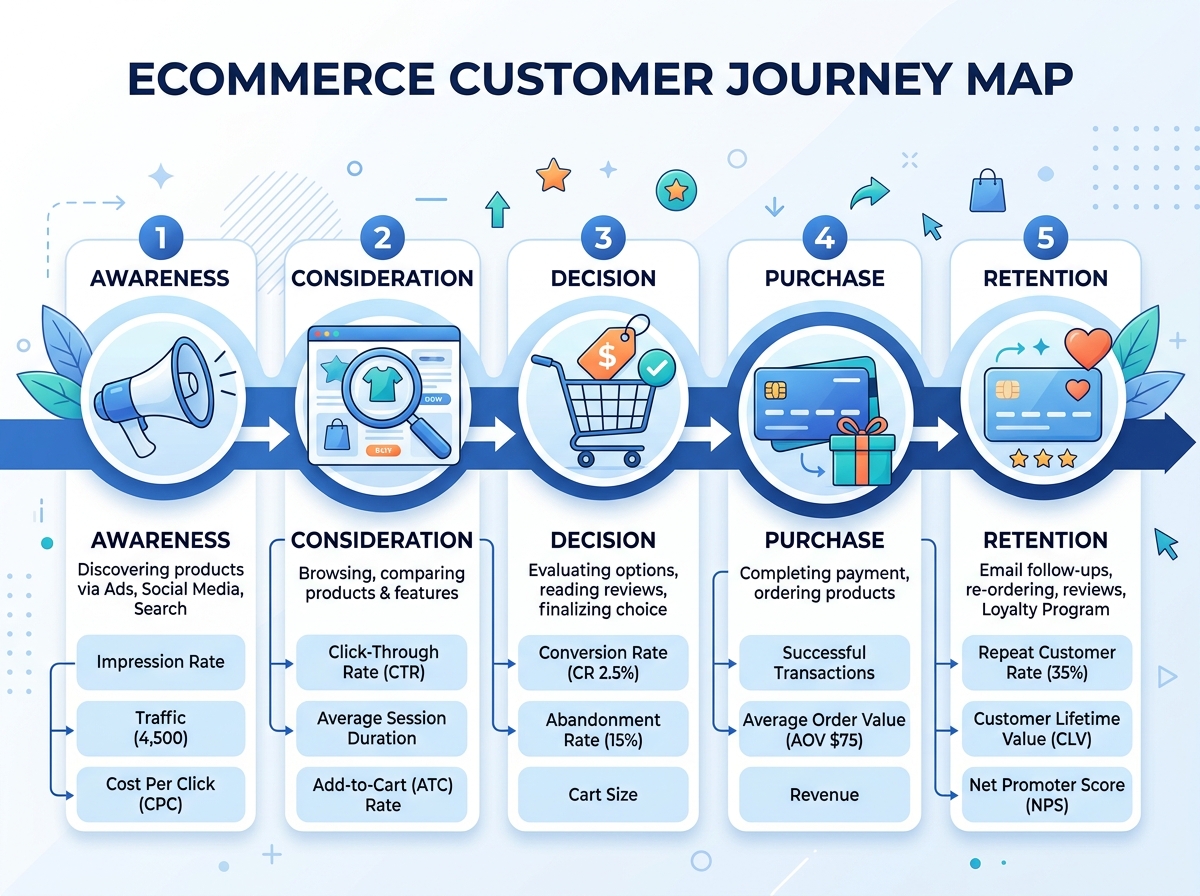
If your online store is getting traffic but not enough sales, the problem might not be your product — it might be the path your customers are taking to buy it. That’s exactly where an ecommerce customer journey map becomes one of the most powerful tools in your marketing toolkit. By understanding every step your customer takes — from first discovering your brand to completing a purchase (and coming back again) — you can remove the friction that’s quietly killing your conversions.
In this post, we’ll walk you through what a customer journey map is, why it matters for your online store, and how to build one that actually drives results.
What Is an Ecommerce Customer Journey Map?
An ecommerce customer journey map is a visual or written breakdown of every interaction a customer has with your brand — from the moment they first hear about you to long after they’ve made a purchase. Think of it as putting yourself in your customer’s shoes and walking through their entire experience, step by step.
Most customer journeys follow a similar pattern, often broken into five key stages:
- Awareness — They discover your brand through social media, search, or word of mouth.
- Consideration — They browse your site, compare products, and read reviews.
- Decision — They add to cart and move toward checkout.
- Purchase — They complete the transaction.
- Retention — They receive follow-up communication and decide whether to return.
Each of these stages is a chance to either win your customer over — or lose them. Mapping these stages helps you see exactly where people are dropping off and what you can do to fix it.
Why Customer Journey Mapping Matters for Your Online Store
Most business owners focus heavily on driving traffic to their store. But if the experience once someone lands on your site is confusing, slow, or untrustworthy, all that traffic goes to waste. Customer journey mapping shifts your focus from just getting visitors to actually converting them.
Here’s what a well-built ecommerce customer journey map can help you uncover:
- Pages where visitors are bouncing or abandoning their carts
- Gaps in your messaging that leave customers with unanswered questions
- Missing trust signals like reviews, guarantees, or clear return policies
- Opportunities to personalize the experience based on where someone is in the buying process
- Weak points in your post-purchase follow-up that are costing you repeat business
When you understand the full picture, you stop guessing and start making strategic improvements that actually move the needle. If you’re also working on your site’s visibility, pairing this with a solid SEO strategy for your ecommerce store will help you attract the right customers in the first place.
How to Build Your Ecommerce Customer Journey Map
Step 1: Define Your Customer Personas
Before you can map a journey, you need to know who’s taking it. Start by creating one or two customer personas — semi-fictional profiles of your ideal buyers. Include details like their age, goals, pain points, preferred social platforms, and how they typically shop online.
The more specific you get, the more useful your journey map will be. A 45-year-old boutique owner shopping for wholesale products has a very different journey than a 22-year-old buying their first skincare product. Don’t try to map for everyone — focus on your best customers first.
Step 2: List Every Touchpoint
A touchpoint is any moment your customer interacts with your brand. This includes your social media posts, Google ads, product pages, email confirmations, packaging, and even your customer service responses. Write them all down for each stage of the journey.
You might be surprised how many touchpoints exist — and how inconsistent the experience can feel across them. This exercise alone often reveals quick wins you can act on immediately.
Step 3: Identify Emotions and Pain Points at Each Stage
For each touchpoint, ask yourself: How is my customer feeling right now, and what might be frustrating them? Someone in the consideration stage might feel overwhelmed by too many product options. Someone at checkout might feel anxious about payment security.
Mapping emotions alongside actions is what separates a surface-level audit from a truly useful ecommerce customer journey map. When you know what your customer is feeling, you can design experiences that address those emotions directly — with better copy, clearer navigation, or stronger social proof.
Step 4: Spot the Gaps and Prioritize Fixes
Now that you have the full picture, look for the moments where the experience breaks down. Common problem areas include:
- Slow page load times that cause drop-offs before the page even loads
- Checkout processes with too many steps or required account creation
- Product descriptions that don’t answer key buying questions
- No follow-up email after purchase to encourage reviews or repeat orders
- Lack of retargeting for visitors who browsed but didn’t buy
Prioritize fixes based on where you’re losing the most customers. If 70% of people abandon at checkout, that’s your first priority — not tweaking your homepage banner. You can also use automation tools to streamline follow-up sequences and recover lost sales. Learn more about how Make.com automation can support your ecommerce workflows without adding hours to your day.
Turning Your Map Into a Conversion Machine
Building the map is just the beginning. The real value comes from using it as a living document that guides your marketing decisions. Review it regularly — especially after launching new products, running promotions, or making changes to your site.
Use tools like Google Analytics, Hotjar, or your email platform’s data to validate what your map is telling you. Real data will confirm where customers are struggling and help you measure whether your fixes are working. If you’re not sure where to start with your analytics setup, our guide on digital marketing tools for small businesses covers the essentials.
The businesses that consistently grow their online revenue aren’t just the ones with the best products — they’re the ones who obsess over the customer experience at every single stage.
Key Takeaways:
- An ecommerce customer journey map outlines every interaction a customer has with your brand, from awareness to retention.
- Mapping emotions and pain points at each stage helps you design experiences that convert — not just attract.
- Touchpoints span across social media, your website, email, and post-purchase communication — all of them matter.
- Identifying where customers drop off lets you prioritize the fixes that will have the biggest impact on conversions.
- Treat your journey map as a living document and update it regularly as your business and customer behavior evolve.
Ready to stop guessing and start growing? At LetsGetSocialOnline.com, we help small businesses and entrepreneurs build smarter digital strategies — from mapping the customer journey to optimizing every touchpoint for conversions. Get in touch with our team today and let’s build a customer experience that turns visitors into loyal buyers.