
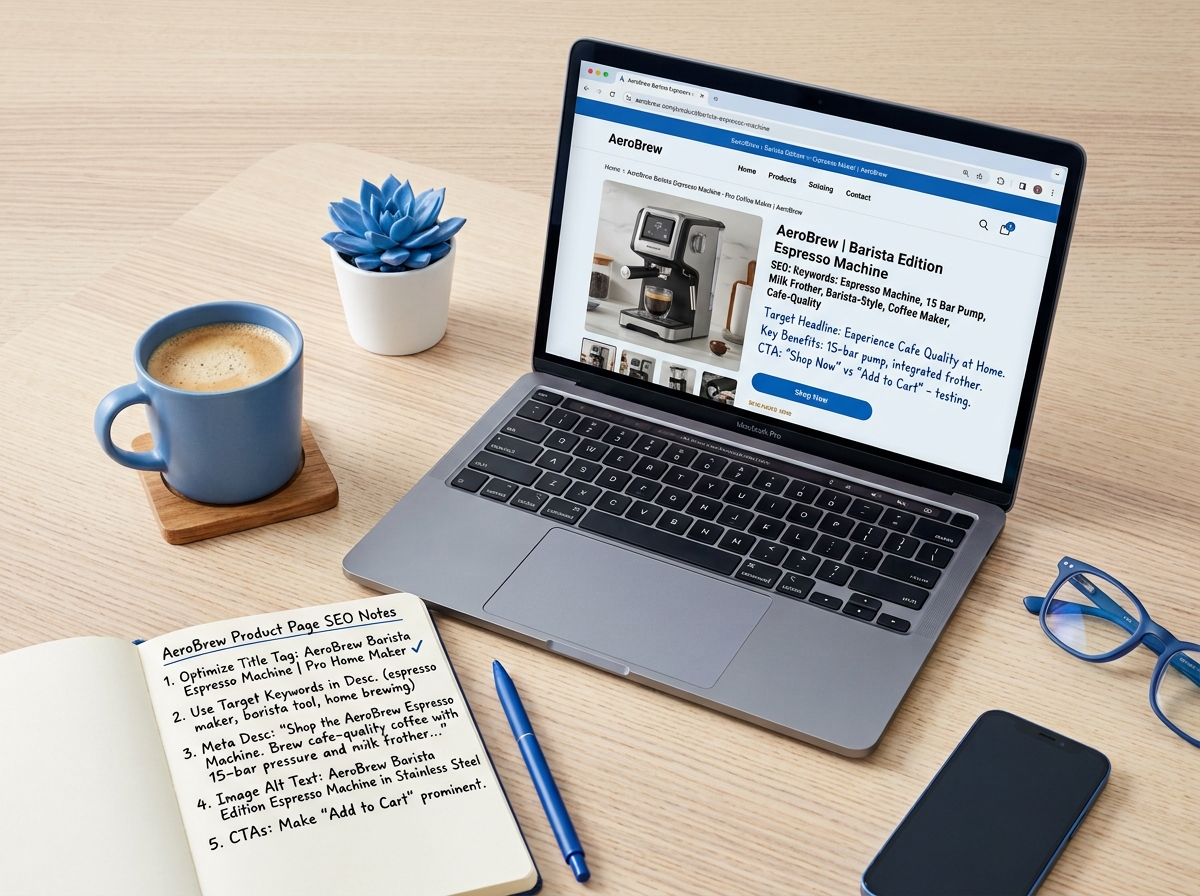
If you run an online store, you already know that getting people to your product pages is only half the battle. The other half? Making sure those pages actually show up on Google — and then convincing visitors to hit “Add to Cart.” That’s exactly where product description SEO copywriting comes in. Done right, it helps your products get discovered, builds trust with shoppers, and drives real sales. In this post, you’ll learn how to write product descriptions that do both jobs at once.
Why Most Product Descriptions Fail (And What to Do Instead)
Most e-commerce store owners make the same mistake: they copy the manufacturer’s description, paste it in, and call it a day. The problem? Every other retailer selling that product is doing the exact same thing. Google sees duplicate content and doesn’t know which page to rank — so it often ranks none of them.
Beyond the SEO issue, generic descriptions don’t speak to your customer. They list features without explaining benefits, and they don’t answer the questions a real shopper has before buying. If your product description reads like a spec sheet, you’re leaving money on the table.
The Fix: Write for Humans First, Then Optimize for Search
The best product descriptions feel like a helpful conversation, not a keyword dump. Start by thinking about who your ideal customer is and what they actually care about. What problem does your product solve? What would make them feel confident enough to buy? Answer those questions in plain, direct language — then layer in your SEO strategy.
How to Structure a Product Description for SEO and Conversions
Strong product description SEO copywriting follows a clear structure. It’s not just about what you say — it’s about how you organize it so both Google and your customers can quickly understand what you’re offering.
Start With a Compelling Opening Line
Your first sentence should hook the reader and include your primary keyword naturally. Think of it as a mini headline for the description itself. For example, instead of “This is a stainless steel water bottle,” try “Stay hydrated all day with this insulated stainless steel water bottle — built for people who are always on the move.” It’s specific, benefit-driven, and searchable.
Use Keywords Strategically (Not Obsessively)
Include your target keyword and related terms in the product title, the first paragraph, and naturally throughout the description. Don’t force it — Google is smart enough to understand context. Focus on using natural language variations that match how your customers actually search. Tools like Google’s autocomplete, Amazon search suggestions, and keyword research tools can help you find the right phrases.
Lead With Benefits, Back Up With Features
Features tell. Benefits sell. Instead of just listing what a product is, explain what it does for the customer. A feature is “double-wall insulation.” A benefit is “keeps your coffee hot for 8 hours, even on the longest commute.” Use a short paragraph for the emotional hook, then follow up with a bullet list of key features for easy scanning.
- Benefit-first opening: Connect emotionally with what the product does for the buyer
- Feature bullet points: Make specs easy to scan and compare
- Social proof cues: Mention bestseller status, ratings, or customer love where relevant
- Clear call-to-action: Guide the reader toward the next step (add to cart, choose a size, etc.)
On-Page SEO Elements You Can’t Ignore
Writing great copy is only part of the equation. To fully optimize your product pages, you need to pay attention to the technical SEO elements that surround your description. These signals help Google understand what your page is about and where to rank it.
Optimize Your Product Title and Meta Description
Your product title (the H1 on the page) should include your primary keyword and be descriptive enough to stand alone in a search result. Your meta description won’t directly affect rankings, but it influences click-through rates — so write it like ad copy. Make it compelling, include the keyword, and keep it under 160 characters.
Use Alt Text on Product Images
Every product image should have descriptive alt text that includes relevant keywords. This helps with Google Image Search and improves accessibility for visually impaired users. Instead of “IMG_4523.jpg,” use something like “red leather crossbody bag with gold zipper.” It’s a small step that adds up across hundreds of product pages.
Don’t Forget URL Structure and Internal Linking
Your product page URLs should be clean, readable, and keyword-rich. Avoid long strings of numbers or random characters. Also, use internal links to connect related products, category pages, and blog content — this helps Google crawl your site and keeps shoppers exploring. For more on this, check out our guide on e-commerce SEO best practices.
Writing Product Descriptions at Scale (Without Losing Quality)
If you have dozens or hundreds of products, writing unique descriptions for each one can feel overwhelming. This is where a smart content strategy — and the right tools — make a huge difference. AI writing tools can help you generate first drafts quickly, but always review and personalize them to match your brand voice and customer needs.
Consider creating a product description template that your team (or AI assistant) can follow consistently. Define your tone, the structure you want, the keywords to target, and the benefits to highlight for each product category. This keeps quality high even when you’re working at volume. You can also explore AI tools for content creation to speed up your workflow without sacrificing quality.
Batch your writing sessions by product category so you stay in the right mindset and maintain a consistent voice. Review descriptions regularly — especially for your top-selling products — to make sure they’re still accurate, competitive, and optimized for current search trends.
Key Takeaways
- Never use duplicate manufacturer descriptions — always write original copy for every product page
- Lead with customer benefits, then support with features in a scannable bullet list
- Use your target keyword naturally in the title, opening paragraph, and throughout the description
- Optimize all on-page elements: meta description, image alt text, URL structure, and internal links
- Use templates and AI tools to scale your product description SEO copywriting without losing quality
Ready to Turn Your Product Pages Into a Sales Engine?
Great product description SEO copywriting isn’t just a nice-to-have — it’s one of the highest-ROI investments you can make in your online store. Every product page is a landing page, and every landing page is an opportunity to rank, connect, and convert. The businesses that treat their product copy seriously are the ones that consistently outperform their competitors in search and sales.
If you’re ready to level up your e-commerce content strategy but aren’t sure where to start, we’re here to help. At LetsGetSocialOnline.com, we work with small businesses and entrepreneurs to build SEO strategies that actually drive results — from product pages to full-site optimization.
Let’s build something that ranks and converts. Get in touch with our team today and let’s talk about what’s possible for your online store.