
If you’ve ever stared at a blank screen wondering why your ad isn’t converting or why your email isn’t getting clicks, the answer might be simpler than you think. The AIDA framework marketing model is one of the most powerful — and most underused — tools in a marketer’s toolkit. It gives you a clear, repeatable structure for every piece of content you create, from social media posts to landing pages to email campaigns.
The best part? You don’t need to be a professional copywriter to use it. Once you understand the four stages, you’ll start seeing them everywhere — and applying them naturally to your own marketing.
What Is the AIDA Framework?
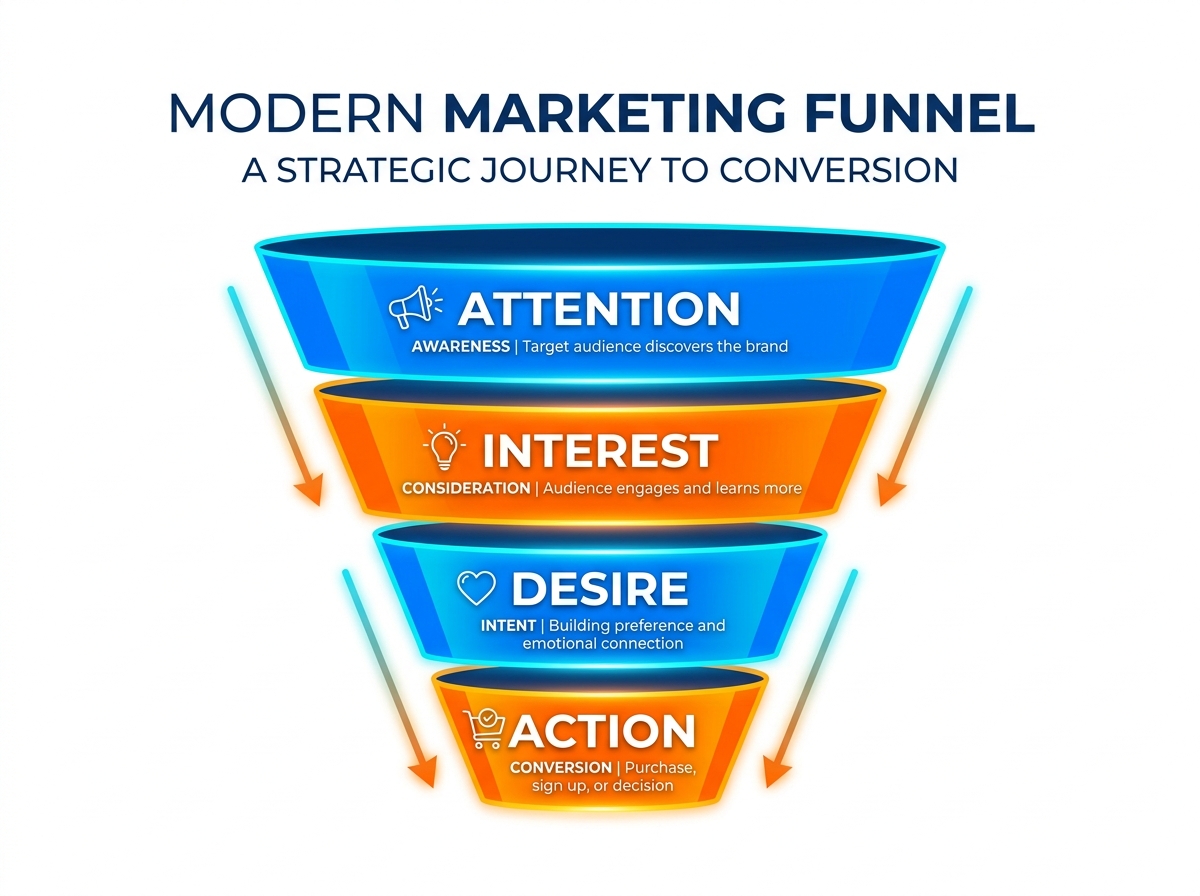
AIDA stands for Attention, Interest, Desire, and Action. It’s a classic marketing model that maps out the psychological journey a customer takes before making a purchase or taking a desired action. Originally developed in the late 1800s by advertising pioneer Elias St. Elmo Lewis, it’s still just as relevant today — maybe even more so in a world full of digital noise.
Think of it as a funnel. At the top, you’re casting a wide net to grab attention. By the bottom, you’re guiding a warm, motivated prospect to take action. Each stage builds on the last, and skipping one is like pulling a leg out from under a table — everything falls apart.
The Four Stages at a Glance
- Attention: Stop the scroll. Make someone notice you.
- Interest: Keep them reading. Show them you understand their problem.
- Desire: Make them want what you’re offering. Paint the picture of a better outcome.
- Action: Tell them exactly what to do next.
How to Apply AIDA to Your Marketing Content
The beauty of the AIDA framework marketing model is that it works across every format and channel. Whether you’re writing a Facebook ad, a product description, or a cold email, the same four-stage structure applies. Let’s break down how to use each stage effectively.
Stage 1 — Attention: Stop the Scroll
Your headline, subject line, or opening image has one job: make someone stop and pay attention. In a world where the average person sees thousands of marketing messages a day, being forgettable is the biggest risk you face. Use a bold statement, a surprising statistic, a relatable pain point, or a compelling question to hook your audience immediately.
For example, instead of “We offer social media management services,” try “Still posting on social media with zero results?” One speaks to you. The other speaks about the business. Big difference.
Stage 2 — Interest: Keep Them Engaged
Once you have their attention, your next job is to hold it. This is where you demonstrate that you understand your reader’s world — their challenges, frustrations, and goals. Share a relevant insight, tell a short story, or present a problem they recognize in themselves.
This is also where a strong content marketing strategy pays off. When your content consistently speaks to your audience’s real concerns, building interest becomes second nature rather than a struggle.
Stage 3 — Desire: Make Them Want It
Interest tells them you understand the problem. Desire makes them believe you have the solution — and that they need it. This is where you highlight benefits (not just features), share social proof like testimonials or case studies, and help your reader visualize the transformation your product or service delivers.
Ask yourself: what does life look like after they work with you or buy your product? Describe that outcome clearly and specifically. “Save 10 hours a week on social media” is far more compelling than “efficient social media tools.”
Stage 4 — Action: Tell Them What to Do Next
This is the stage most small business owners rush — or forget entirely. A strong call-to-action (CTA) is specific, low-friction, and urgent. Don’t just say “contact us.” Say “Book your free 30-minute strategy call today” or “Download the free guide now.” Remove any doubt about what happens next and make the next step feel easy and worthwhile.
Real-World AIDA Examples for Small Businesses
Let’s put this into practice with a few quick examples so you can see how the AIDA framework marketing model looks in action across different formats.
Email Campaign Example
- Attention: Subject line — “Your competitors are getting leads while you sleep. Here’s how.”
- Interest: Opening paragraph about the challenge of generating consistent leads without a big team.
- Desire: A short case study showing how a similar business doubled their leads using automation.
- Action: “Click here to see how we can set this up for your business — free consultation included.”
Social Media Ad Example
- Attention: Bold visual with the text “Still doing everything manually?”
- Interest: “Most small business owners waste 15+ hours a week on tasks that could be automated.”
- Desire: “Our clients reclaim their time and grow faster — without hiring more staff.”
- Action: “Learn more → Book a free demo today.”
You can apply this same structure to landing pages, video scripts, blog posts, and even your website’s homepage. If you’re also working on SEO for your small business, combining strong AIDA-driven copy with optimized content is a winning combination.
Common AIDA Mistakes to Avoid
Even with a solid framework, there are a few pitfalls that can undermine your results. Watch out for these common errors when applying the AIDA framework marketing model to your content.
- Leading with features instead of benefits — People don’t buy products; they buy outcomes. Always translate features into what they mean for the customer.
- Weak or missing CTAs — Every piece of marketing needs a clear next step. Don’t leave your audience guessing.
- Skipping the desire stage — Many marketers jump from interest straight to action without building enough emotional pull. Give people a reason to care before you ask them to act.
- Using the same message for every audience — AIDA works best when it’s tailored. A first-time visitor needs a different message than a warm lead who’s already engaged with your brand.
Key Takeaways
- The AIDA framework marketing model — Attention, Interest, Desire, Action — gives you a proven structure for every piece of content you create.
- Each stage serves a specific purpose: grab attention, build interest, create desire, and prompt action.
- AIDA works across all formats: emails, ads, landing pages, social media posts, and more.
- Strong CTAs are non-negotiable — always tell your audience exactly what to do next.
- Tailor your AIDA messaging to where your audience is in their buying journey for the best results.
Once you start using AIDA consistently, you’ll notice a real shift in how your marketing performs. It’s not magic — it’s just a smarter way to communicate. And when you pair it with the right tools and strategy, the results can be significant. If you’re looking to level up your digital marketing strategy and start creating content that actually converts, we’d love to help.
Ready to put the AIDA framework to work for your business? Get in touch with our team today and let’s build a marketing strategy that moves people from curious to converted.