
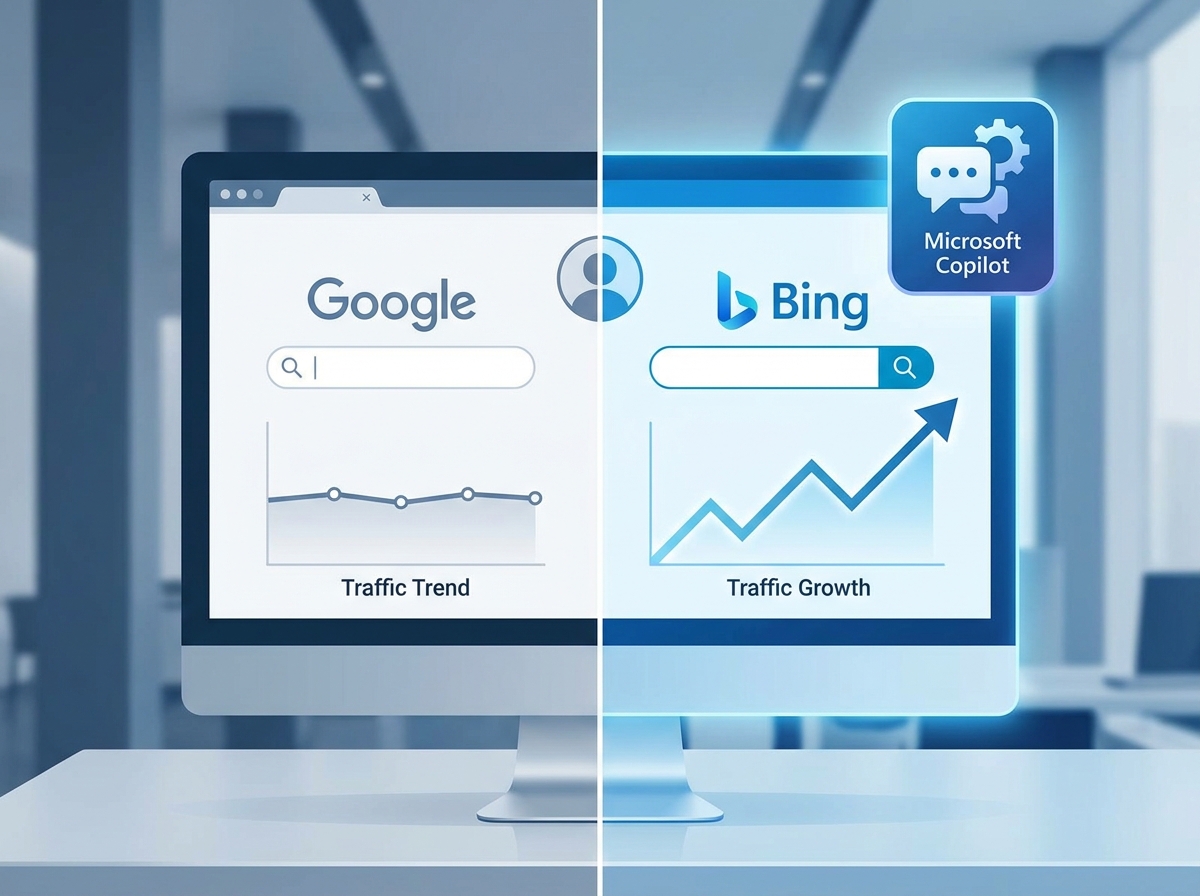
If you’ve been laser-focused on Google and ignoring everything else, you’re not alone — but in Bing SEO 2026, that approach might be costing you real traffic and real customers. Bing has quietly grown into a search engine worth taking seriously, especially with Microsoft’s deep integration of AI into its search experience. Before you dismiss it, let’s look at the numbers, the opportunities, and exactly what you need to do to make Bing work for your business.
Why Bing Deserves a Spot in Your SEO Strategy
Bing currently holds around 26–30% of the U.S. desktop search market, and that number has been climbing steadily since Microsoft integrated ChatGPT-powered AI into its search results. That’s not a small slice — that’s roughly one in four searches happening outside of Google. If your business only optimizes for Google, you’re potentially invisible to millions of people every single day.
Beyond raw market share, Bing’s user base skews toward older, higher-income demographics — people who are often more ready to buy. If you’re selling products or services to adults aged 35 and up, Bing’s audience could be a goldmine you’ve been ignoring. Add in the fact that Bing powers search results for Microsoft Edge, Cortana, Xbox, and parts of Amazon’s Alexa, and the reach becomes even more significant.
The AI Factor: Bing Copilot and Search in 2026
Microsoft’s Bing Copilot — its AI-powered search assistant — has changed how people interact with search results. Instead of just clicking links, users are getting AI-generated answers pulled directly from indexed web content. This means your content needs to be clear, authoritative, and well-structured to be featured in these AI responses. Sound familiar? It’s the same principle driving Google’s AI Overviews, which means good content strategy works across both platforms.
The good news is that Bing’s AI search actually rewards well-written, factual, and structured content more transparently than Google does. If you’re already investing in quality content for Google, you’re closer to Bing-ready than you think.
How Bing SEO in 2026 Differs From Google SEO
While the fundamentals of SEO — quality content, backlinks, technical health — apply to both search engines, there are some meaningful differences in how Bing ranks pages. Understanding these nuances can give your business a real competitive edge, especially since most of your competitors aren’t even thinking about Bing optimization.
Key Ranking Factors Unique to Bing
- Domain age and authority: Bing places more weight on how long your domain has been active and trusted. Established businesses have a natural advantage here.
- Exact-match keywords: Bing still responds well to exact-match keywords in titles, headings, and meta descriptions — slightly more so than Google, which has moved toward semantic search.
- Social signals: Bing openly acknowledges that social media engagement can influence rankings. Active social profiles and shared content can give you a boost. Check out our guide on social media management strategies to strengthen this side of your presence.
- Clear authorship and E-E-A-T signals: Bing rewards content that clearly identifies the author and demonstrates expertise. Author bios, credentials, and linked profiles matter.
- Page load speed and mobile optimization: Just like Google, Bing cares about technical performance — fast pages and mobile-friendly design are non-negotiable.
- Multimedia content: Bing tends to favor pages that include images, videos, and structured data more visibly than Google does in standard results.
Bing Webmaster Tools: Your Secret Weapon
Bing Webmaster Tools is free, powerful, and criminally underused by most small businesses. It gives you direct insight into how Bing crawls and indexes your site, keyword performance data, backlink reports, and even an SEO analyzer that flags issues on your pages. If you haven’t set it up yet, it should be on your to-do list this week.
One standout feature is the ability to submit URLs for indexing manually, which can get your new content discovered by Bing much faster than waiting for a crawl. For businesses publishing regular blog content or launching new service pages, this is a huge time-saver.
Practical Steps to Optimize for Bing SEO in 2026
The great news about Bing SEO in 2026 is that most of the work overlaps with what you’re already doing for Google. You don’t need a completely separate strategy — just a few targeted adjustments. Here’s where to focus your energy:
- Claim and verify your site in Bing Webmaster Tools — this is step one, full stop.
- Submit your XML sitemap directly through Bing Webmaster Tools to ensure all your pages are indexed.
- Use structured data markup (Schema.org) on your key pages — Bing uses this heavily for rich results and AI-generated answers.
- Optimize your meta titles and descriptions with clear, keyword-rich language. Bing reads these more literally than Google.
- Build your local presence by claiming your Microsoft Bing Places for Business listing — this is Bing’s version of Google Business Profile and is essential for local SEO.
- Create content with clear headings and structured formatting so Bing’s AI can easily extract and feature your information.
- Earn backlinks from reputable, relevant sites — Bing values link quality just as much as Google does.
If you’re already working on your SEO strategy for Google, applying these tweaks for Bing won’t take much extra effort — but the payoff can be significant, especially in less competitive niches where Bing rankings are easier to achieve.
Is Bing SEO Worth the Investment for Small Businesses?
Here’s the honest answer: yes, especially if you’re in a competitive Google market. Bing’s search results pages are often less saturated than Google’s, which means a well-optimized page can rank faster and hold its position longer. For small businesses and entrepreneurs who don’t have the budget to compete with big brands on Google, Bing can be a smarter, more cost-effective battleground.
Think about it this way — if Bing drives even 15–20% of the traffic that Google does for your business, that’s a meaningful increase in leads and revenue without spending a single extra dollar on ads. When you combine Bing optimization with a solid content marketing strategy, the compounding effect on your overall search visibility can be substantial.
The businesses that will win in search over the next few years are the ones treating SEO as a multi-platform strategy — not just a Google game. Bing SEO in 2026 is no longer optional for growth-focused businesses. It’s a smart, underutilized opportunity sitting right in front of you.
Key Takeaways
- Bing holds 26–30% of U.S. desktop search market share and is growing thanks to AI integration with Microsoft Copilot.
- Bing’s audience skews older and higher-income — a valuable demographic for many businesses.
- Bing ranks content differently from Google, placing more emphasis on exact-match keywords, social signals, and clear authorship.
- Bing Webmaster Tools and Bing Places for Business are free, powerful tools that most small businesses haven’t set up yet.
- Optimizing for Bing requires minimal extra effort if you already have a Google SEO strategy in place — and the ROI can be significant.
Ready to stop leaving traffic on the table? Whether you need help building a full SEO strategy, setting up Bing Webmaster Tools, or creating content that ranks across every major search engine, our team is here to help. Get in touch with us today and let’s build a search strategy that works harder for your business in 2026 and beyond.