
What Is Conversion Rate Optimization and Why Does It Matter?
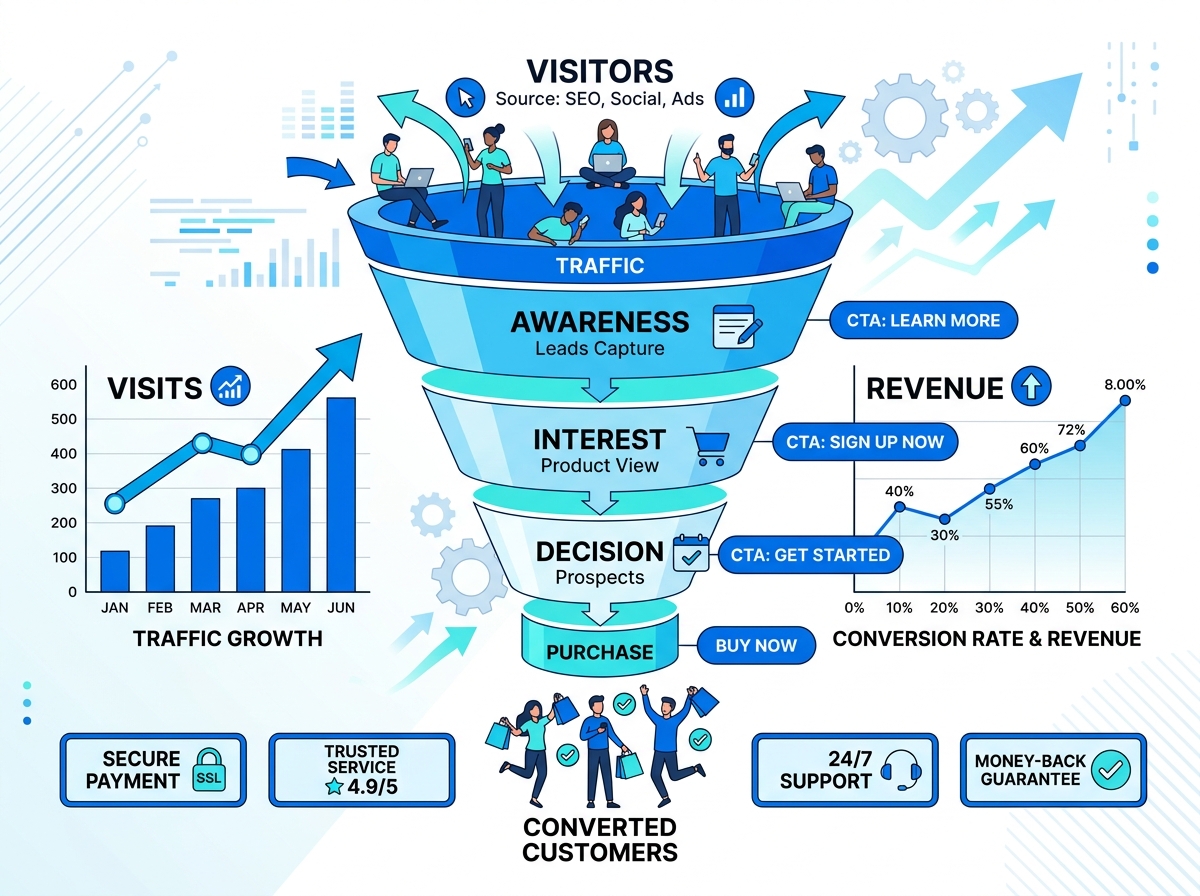
If you’re driving traffic to your website but not seeing the sales, sign-ups, or leads you expected, you’re not alone. This is exactly where conversion rate optimization comes in. Simply put, conversion rate optimization (CRO) is the process of improving your website so that a higher percentage of your visitors take a desired action — whether that’s making a purchase, filling out a form, or subscribing to your newsletter.
Instead of spending more money to attract new visitors, CRO helps you get more value from the traffic you already have. For small business owners and digital marketers working with limited budgets, this is a game-changer. Even a small improvement in your conversion rate can lead to a significant boost in revenue without increasing your ad spend.
Understanding Your Conversion Rate
Before you can improve your conversion rate, you need to know what it is. The formula is straightforward:
Conversion Rate = (Number of Conversions ÷ Total Visitors) × 100
For example, if your website receives 2,000 visitors per month and 60 of them make a purchase, your conversion rate is 3%. The average conversion rate across industries typically falls between 2% and 5%, but top-performing websites often achieve rates of 10% or higher. Knowing your baseline is the first step toward meaningful improvement.
Key Elements That Affect Your Conversions
Many factors influence whether a visitor converts or bounces. Understanding these elements gives you a clear roadmap for where to focus your optimization efforts.
1. Website Speed and Performance
A slow website kills conversions. Studies show that a one-second delay in page load time can reduce conversions by up to 7%. Use tools like Google PageSpeed Insights to identify performance issues and fix them quickly. Compress images, enable browser caching, and consider upgrading your hosting plan if necessary.
2. Clear and Compelling Headlines
Your headline is the first thing visitors see. It needs to immediately communicate your value proposition and speak directly to your target audience’s pain points. A strong headline answers the question: “What’s in it for me?” Test different headline variations to see which resonates most with your audience.
3. Trust Signals
People buy from businesses they trust. Adding trust signals to your website can dramatically improve your conversion rate. These include:
- Customer reviews and testimonials — Social proof that others have had positive experiences
- Security badges and SSL certificates — Reassurance that personal data is safe
- Money-back guarantees — Reducing the perceived risk of purchasing
- Case studies and success stories — Demonstrating real-world results
- Media mentions and awards — Building credibility and authority
4. Strong Calls-to-Action (CTAs)
Your call-to-action is arguably the most critical element on any page. A weak or confusing CTA will cost you conversions every single day. Make your CTAs specific, action-oriented, and visually prominent. Instead of a generic “Submit” button, try something like “Get My Free Quote” or “Start My Free Trial Today.” The more specific and benefit-driven your CTA, the better it will perform.
5. Mobile Optimization
With more than half of all web traffic coming from mobile devices, a poor mobile experience is a conversion killer. Ensure your website is fully responsive, that buttons are easy to tap, and that forms are simple to complete on a small screen. A seamless mobile experience is no longer optional — it’s essential.
Beginner-Friendly CRO Strategies to Implement Today
You don’t need a massive budget or a team of developers to start improving your conversion rate optimization results. Here are practical strategies any beginner can implement right away.
Run A/B Tests
A/B testing (also called split testing) involves creating two versions of a page or element and showing each version to a different segment of your audience. You then measure which version performs better. Start small — test one element at a time, such as your headline, CTA button color, or hero image. Tools like Google Optimize, Optimizely, or VWO make this process accessible even for beginners.
Simplify Your Forms
Every additional field in a form is a potential reason for a visitor to abandon it. Only ask for the information you absolutely need. If you’re collecting email leads, a name and email address is often enough to start. You can always gather more information later in the customer journey.
Use Heatmaps and Session Recordings
Tools like Hotjar or Microsoft Clarity allow you to see exactly how visitors interact with your website. Heatmaps show where people click, scroll, and spend the most time. Session recordings let you watch real user behavior. This data is invaluable for identifying friction points and opportunities for improvement.
Optimize Your Landing Pages
If you’re running paid ads or email campaigns, your landing pages need to be laser-focused on a single goal. Remove navigation menus, minimize distractions, and ensure the messaging on your landing page matches the ad or email that brought the visitor there. This alignment — known as message match — is one of the fastest ways to improve your conversion rate optimization results.
Leverage Social Proof Strategically
Don’t just add testimonials to your homepage and forget about them. Place social proof near your CTAs, on product pages, and throughout your checkout process. Real customer photos, star ratings, and specific results (e.g., “Increased revenue by 40% in 90 days”) are far more persuasive than generic praise.
Measuring Your CRO Success
Effective conversion rate optimization is an ongoing process, not a one-time fix. Set up Google Analytics 4 to track your key conversion goals and monitor your results regularly. Pay attention to metrics like bounce rate, time on page, exit rate, and funnel drop-off points. These numbers tell the story of where visitors are losing interest and where your biggest opportunities lie.
Remember, even small wins add up. Improving your conversion rate from 2% to 3% might sound modest, but it represents a 50% increase in conversions from the same amount of traffic. Over time, these incremental improvements compound into significant business growth.
Common CRO Mistakes to Avoid
- Testing too many things at once — This makes it impossible to know what actually caused a change in performance
- Ending tests too early — Give your tests enough time to reach statistical significance before drawing conclusions
- Ignoring mobile users — Always test and optimize for mobile as well as desktop
- Focusing only on the homepage — Every page on your site is an opportunity to convert visitors
- Copying competitors blindly — What works for another business may not work for yours; always test with your own audience
Start Your CRO Journey Today
Mastering conversion rate optimization doesn’t happen overnight, but every step you take brings you closer to a website that works harder for your business. Start by auditing your current conversion rate, identifying your biggest friction points, and running your first A/B test. Small, consistent improvements will deliver compounding results over time.
Whether you’re running an e-commerce store, a service-based business, or a content website, CRO is one of the highest-ROI activities you can invest in. The traffic is already coming — now it’s time to make the most of it.
Ready to take your website performance to the next level? Explore our other guides on landing page optimization and A/B testing strategies to keep building your CRO knowledge. And if you’d like a personalized audit of your website’s conversion opportunities, contact our team today — we’d love to help you grow.