
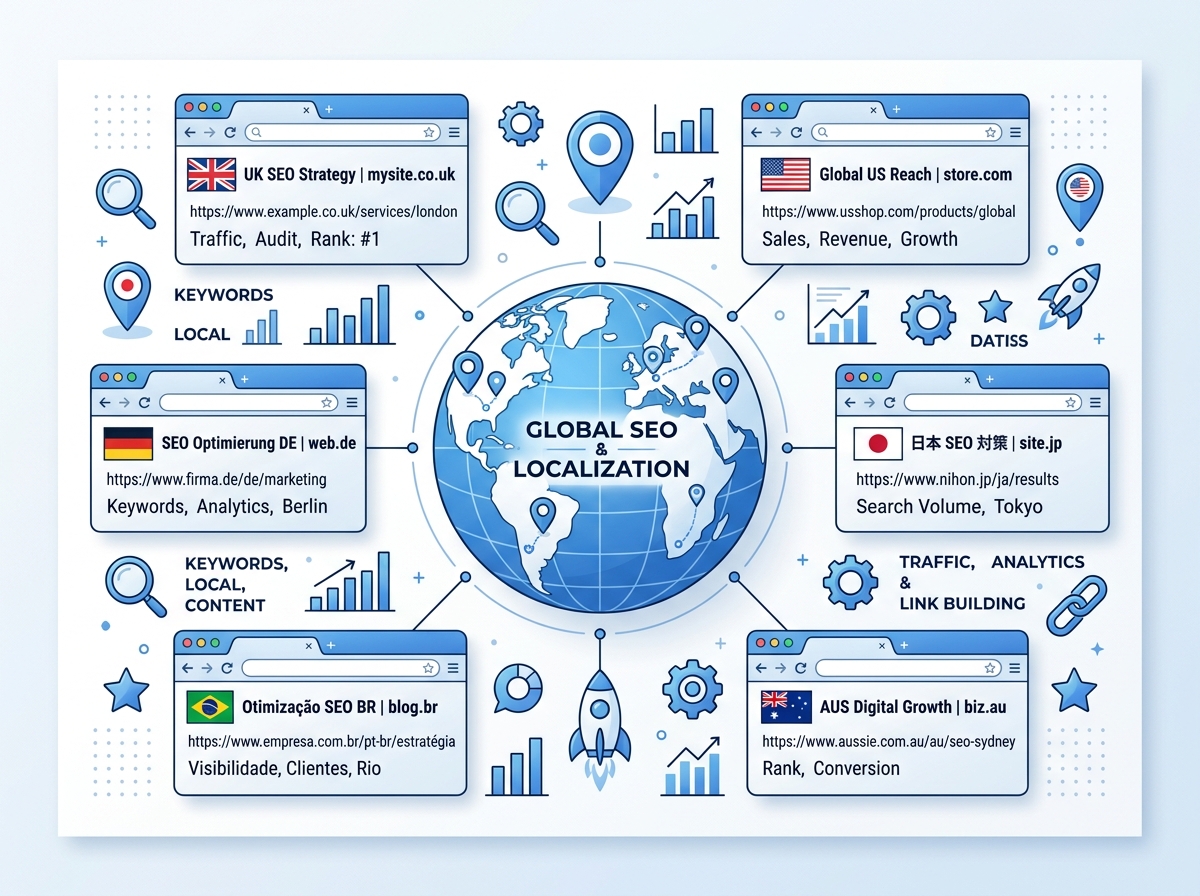
If you’ve been thinking about growing your business beyond your home country, you’re not alone. More small businesses and entrepreneurs are discovering that the internet makes global expansion more accessible than ever. But to actually show up in search results in other countries, you need to understand international SEO basics — and that’s exactly what this guide is here to help with.
International SEO isn’t just about translating your website. It’s about making sure search engines like Google understand which countries and languages you’re targeting, so they can serve your content to the right people in the right places. Done well, it can open up entirely new revenue streams for your business.
What Is International SEO and Why Does It Matter?
International SEO is the process of optimizing your website so it ranks in search engines across multiple countries or languages. Think of it as your website’s passport — it tells Google where your content belongs and who it’s meant for.
Without proper international SEO, your website might rank well in the US but be completely invisible in the UK, Canada, Australia, or any other market you’re trying to reach. That means missed traffic, missed leads, and missed sales. Getting the basics right from the start saves you a lot of headaches down the road.
The Difference Between Multilingual and Multinational SEO
Multilingual SEO focuses on targeting users who speak different languages — for example, creating English and Spanish versions of your site. Multinational SEO focuses on targeting users in specific countries, even if they speak the same language. For instance, the US and Australia both speak English, but search behavior, spelling, and even product preferences can differ significantly.
Many businesses need a combination of both. Understanding which approach fits your goals is one of the first steps in building a solid international SEO strategy. If you’re also working on your overall SEO foundation, check out our guide on SEO basics for small businesses before diving into global expansion.
Key Technical Elements of International SEO
Once you understand the concept, it’s time to look at the technical side. Don’t worry — you don’t need to be a developer to understand these fundamentals. You just need to know what they are and why they matter.
Hreflang Tags: Telling Google Who Your Content Is For
Hreflang tags are small pieces of code added to your website that tell search engines which language and country a specific page is targeting. For example, a hreflang tag can signal that one page is for English speakers in the US, while another is for English speakers in the UK, and another is for French speakers in France.
Without hreflang tags, Google might show the wrong version of your page to the wrong audience — or worse, treat your translated pages as duplicate content and penalize your rankings. Getting these tags right is one of the most important parts of international SEO basics.
URL Structure: Choosing the Right Format
There are three main URL structures used in international SEO:
- Country Code Top-Level Domains (ccTLDs) — e.g., yoursite.co.uk or yoursite.fr. These send the strongest geographic signal but require more resources to manage.
- Subdirectories — e.g., yoursite.com/uk/ or yoursite.com/fr/. This is the most popular option for small businesses because it keeps everything under one domain and is easier to manage.
- Subdomains — e.g., uk.yoursite.com. This is a middle-ground option, though Google treats subdomains somewhat separately from the main domain.
For most small businesses just getting started with international SEO, subdirectories are the recommended approach. They’re cost-effective, easier to maintain, and still send clear signals to search engines about your target regions.
Content Strategy for International Markets
Technical setup is only half the battle. Your content also needs to speak directly to your international audience — and that goes beyond just running your text through a translation tool.
Localization vs. Translation
Translation converts your words from one language to another. Localization adapts your entire message — including tone, cultural references, currency, date formats, and even imagery — to feel native to your target market. Localization is what separates a website that technically exists in another language from one that actually connects with that audience.
For example, a call-to-action that works brilliantly in American English might fall flat in British English, or feel completely out of place in a French-speaking market. Investing in proper localization shows your international audience that you understand and respect their culture.
Keyword Research for Each Market
Here’s something many businesses overlook: keywords are not universal. The terms people search for in the UK may be completely different from what people search for in the US, even in the same language. “Trainers” vs. “sneakers,” “holiday” vs. “vacation” — these differences matter in search.
You need to conduct separate keyword research for each target market using tools like Google Keyword Planner, Ahrefs, or Semrush. This ensures your content is optimized for the actual words your international audience is typing into search engines. For more on building a keyword strategy, explore our post on keyword research for small businesses.
Common International SEO Mistakes to Avoid
Even well-intentioned businesses make mistakes when expanding internationally. Here are the most common pitfalls to watch out for:
- Using auto-translated content without human review — it often reads unnaturally and damages credibility
- Forgetting to set up Google Search Console for each target country
- Ignoring local link building — backlinks from local websites in your target country carry significant weight
- Assuming one SEO strategy works for all markets — always tailor your approach
- Neglecting page speed for international users — hosting location can affect load times for overseas visitors
Key Takeaways
- International SEO basics involve helping search engines understand which countries and languages your content targets.
- Hreflang tags are essential for directing the right audience to the right version of your pages.
- Subdirectories (e.g., yoursite.com/uk/) are the most practical URL structure for small businesses going global.
- Localization goes beyond translation — it adapts your content to resonate culturally with your target market.
- Always conduct market-specific keyword research; search terms vary significantly between countries and regions.
Ready to Take Your Website Global?
Expanding into new markets is one of the most exciting growth opportunities available to modern businesses — and with the right international SEO strategy in place, your website can become your most powerful global sales tool. The key is to start with a solid foundation: the right technical setup, localized content, and market-specific keyword research.
If you’re not sure where to begin, or you want expert help building an international SEO strategy that actually delivers results, we’re here for you. Our team at LetsGetSocialOnline.com specializes in helping small businesses and entrepreneurs grow their digital presence — locally and globally. You can also learn more about how we approach SEO services for growing businesses to see how we can support your goals.
Don’t let borders limit your business growth. Reach out to our team today and let’s build an international SEO strategy that puts your website in front of the right audience, no matter where in the world they are.
Contact LetsGetSocialOnline.com and let’s grow your global presence →