
Why Meta Description Writing Is One of the Most Underrated SEO Skills
You’ve done the hard work — you’ve published a great blog post, optimized your headings, and built some solid backlinks. But if your meta description writing is weak, you’re leaving clicks on the table every single day. Meta descriptions are your first real sales pitch to a potential visitor, and getting them right can dramatically improve your click-through rate (CTR) from search results.
In this guide, we’ll break down exactly what makes a meta description work, share proven formulas, and give you actionable tips you can apply to every page on your website — starting today.
What Is a Meta Description (And Why Does It Matter)?
A meta description is the short snippet of text — typically 150–160 characters — that appears beneath your page title in Google’s search results. While it’s not a direct ranking factor, it plays a massive role in whether someone clicks your link or scrolls past it.
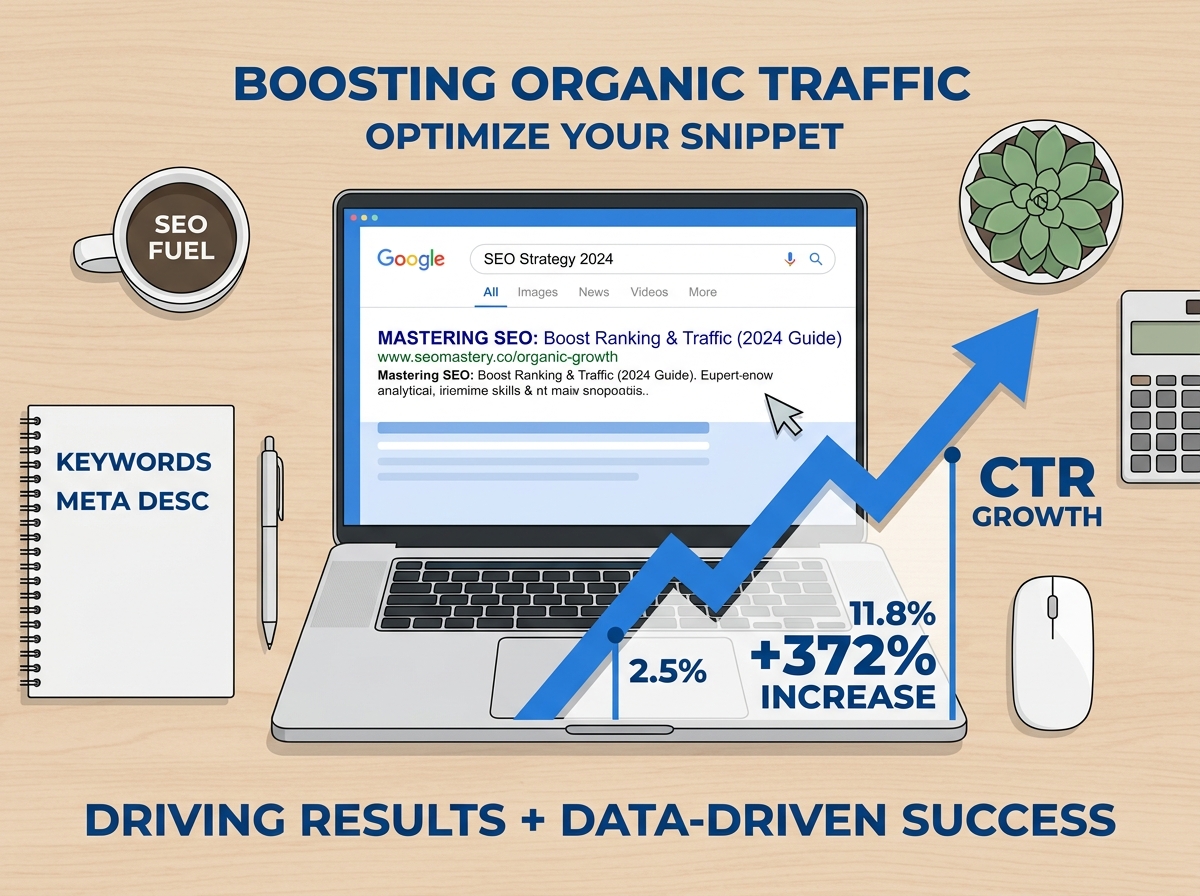
Think of it this way: your title tag gets you noticed, but your meta description closes the deal. A well-crafted description can mean the difference between a 3% CTR and a 12% CTR on the same page. That’s four times more traffic without changing a single word of your content.
The Anatomy of a High-Performing Meta Description
Before you start writing, it helps to understand what separates a forgettable snippet from one that compels action. Every great meta description shares a few key characteristics:
- Relevance: It directly matches the user’s search intent.
- Clarity: It tells the reader exactly what they’ll get when they click.
- Value: It highlights a benefit, solution, or unique angle.
- Action: It includes a call-to-action that encourages the click.
- Length: It stays within 150–160 characters to avoid being cut off.
Step-by-Step Guide to Meta Description Writing That Converts
1. Start With Search Intent
The foundation of effective meta description writing is understanding why someone is searching in the first place. Are they looking for information? Trying to buy something? Comparing options? Your description needs to speak directly to that intent.
For example, if someone searches “how to fix a slow website,” they want a solution — not a product pitch. Your meta description should promise exactly that: a clear, actionable answer waiting for them on the other side of the click.
2. Lead With Your Strongest Benefit
You have roughly 155 characters to make an impression. Don’t waste the first 30 on filler phrases like “In this article, we will discuss…” Instead, lead with the most compelling benefit or outcome your page delivers.
Weak: “This post talks about ways to improve your email marketing strategy.”
Strong: “Boost your email open rates by 40% with these 7 proven strategies — no paid tools required.”
See the difference? The second version is specific, benefit-driven, and creates curiosity.
3. Use Your Focus Keyword Naturally
Including your target keyword in your meta description is important — not because it directly affects rankings, but because Google bolds matching keywords in search results. This makes your snippet visually stand out and signals to the user that your page is exactly what they searched for.
That said, don’t force it. Good meta description writing always prioritizes readability over keyword stuffing. If the keyword fits naturally, use it. If it makes the sentence awkward, rephrase.
4. Add a Clear Call-to-Action
Every high-converting meta description ends with a nudge. Use action-oriented language that tells the reader what to do next:
- “Learn how →”
- “Get started today.”
- “Discover the full guide.”
- “See the examples inside.”
- “Find out what works.”
These micro-CTAs create momentum and make clicking feel like the natural next step.
5. Create Urgency or Exclusivity When Appropriate
Urgency and exclusivity are powerful psychological triggers. Phrases like “limited time,” “don’t miss,” “only available here,” or “updated for 2025” can give your snippet an edge — especially in competitive niches where multiple results look nearly identical.
Use these sparingly and only when they’re genuinely true. Misleading descriptions might get the click, but they’ll also increase your bounce rate, which signals to Google that your page didn’t deliver on its promise.
Common Meta Description Writing Mistakes to Avoid
Even experienced marketers make these errors. Here’s what to watch out for:
- Duplicate descriptions: Every page should have a unique meta description. Copying the same snippet across multiple pages confuses both users and search engines.
- Going over the character limit: Descriptions longer than 160 characters get truncated mid-sentence, which looks unprofessional and loses your CTA.
- Being too vague: “We offer great services at competitive prices” tells the reader nothing. Be specific about what you offer and who it’s for.
- Ignoring mobile users: Google often shows shorter snippets on mobile. Front-load your most important information in the first 120 characters.
- Skipping descriptions entirely: If you leave the meta description blank, Google will auto-generate one — and it rarely picks the best text from your page.
Meta Description Formulas That Work
If you’re staring at a blank field and don’t know where to start, these proven meta description writing formulas can help:
- Problem → Solution: “Struggling with [problem]? Discover [solution] that [benefit]. [CTA].”
- Number + Benefit: “[X] ways to [achieve goal] — without [common obstacle]. [CTA].”
- Question + Promise: “Want to [desired outcome]? Here’s exactly how to [do it] in [timeframe]. [CTA].”
- Feature + Benefit: “[Product/Service] that [does X] so you can [achieve Y]. [CTA].”
Mix and match these structures based on the page type — blog posts, product pages, landing pages, and service pages each have slightly different goals and audiences.
How to Test and Improve Your Meta Descriptions Over Time
Great meta description writing isn’t a one-and-done task. Use Google Search Console to monitor the CTR of your most important pages. If a page ranks well but has a low CTR, that’s a clear signal your description needs work.
Try rewriting the description with a stronger benefit or a different angle, then track the change over 4–6 weeks. Small tweaks can lead to significant traffic gains — especially on pages that already rank on page one.
You can also look at your competitors’ snippets for inspiration. Search your target keyword and study what the top results are saying. Then write something that stands out from the crowd rather than blending in.
Start Writing Meta Descriptions That Actually Work
Every page on your website is an opportunity to earn a click — or lose one. Investing time in meta description writing is one of the highest-ROI SEO tasks you can do, because it improves your traffic without requiring new content or link building.
Apply the strategies in this guide to your top-performing pages first, then work your way through the rest of your site. You’ll be surprised how quickly a few well-crafted sentences can move the needle on your organic traffic.
Ready to take your SEO strategy to the next level? Explore our other guides on on-page SEO, content optimization, and keyword research to build a complete search strategy that drives real results. And if you need help auditing your current meta descriptions, contact our team today — we’re here to help you turn more searches into clicks.