
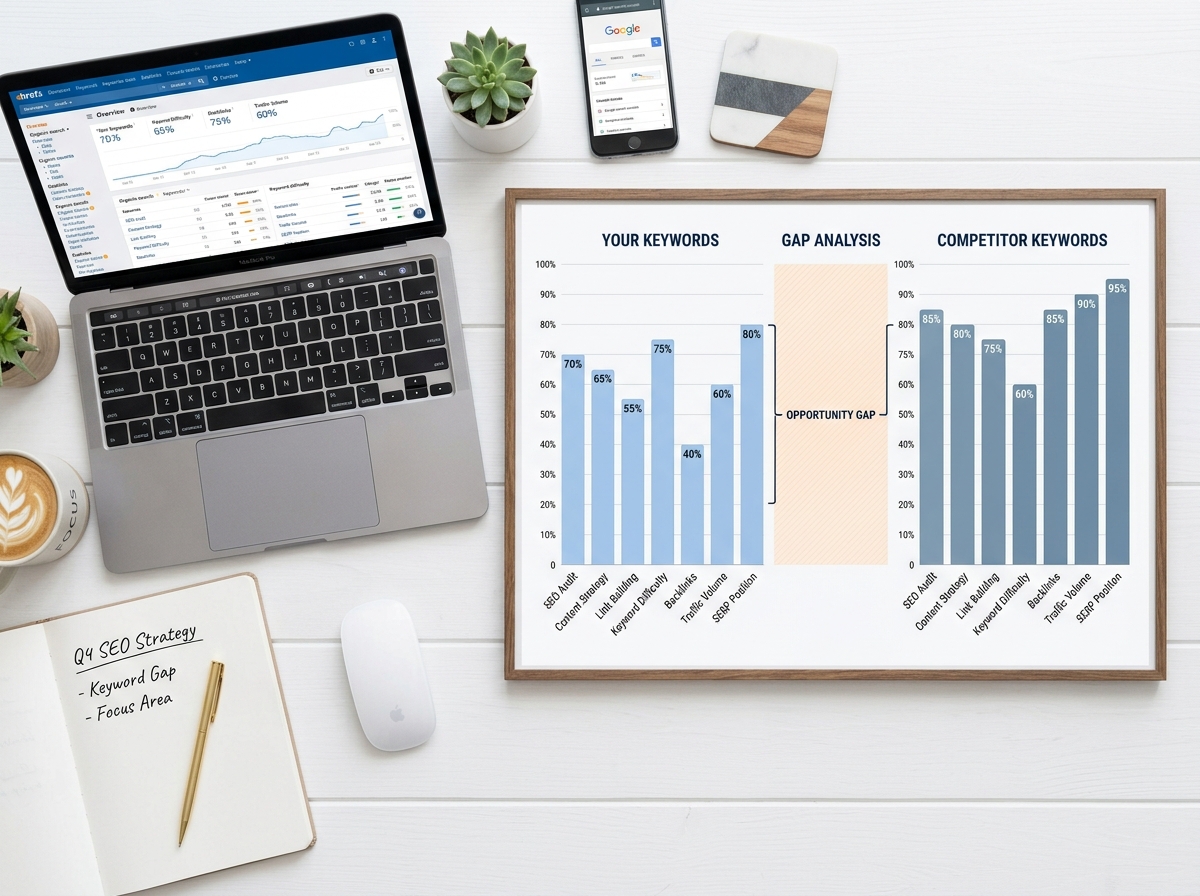
If your competitors are showing up in search results and you’re not, there’s a good chance they’re targeting keywords you’ve completely overlooked. That’s exactly what a competitor keyword gap analysis is designed to fix. It’s one of the most powerful — and underused — SEO strategies available to small business owners and digital marketers. In this guide, you’ll learn exactly how to do one, what tools to use, and how to turn the insights into real rankings.
What Is a Competitor Keyword Gap Analysis?
A competitor keyword gap analysis is the process of comparing the keywords your competitors rank for against the keywords your website currently ranks for. The “gap” is the list of valuable search terms your competitors are capturing traffic from — but you aren’t. These are your missed opportunities.
Think of it like this: if a competitor is ranking on page one for “best accounting software for freelancers” and you offer the same solution but haven’t targeted that phrase, you’re leaving potential customers on the table. A keyword gap analysis helps you find those blind spots and build a smarter content strategy around them.
Why This Matters for Your Business
Most businesses focus on the keywords they already know — their brand name, their main service, maybe a few product terms. But your competitors may be pulling in traffic from dozens or even hundreds of related terms you’ve never considered. Closing that gap means more visibility, more traffic, and ultimately more leads.
This strategy is especially valuable for small businesses competing against larger brands. Instead of trying to outrank everyone on broad, competitive terms, a keyword gap analysis helps you find specific, high-intent keywords where you can realistically compete and win.
How to Run a Competitor Keyword Gap Analysis Step by Step
Step 1: Identify Your Top Competitors
Start by listing three to five businesses that compete with you online — not just in your industry, but specifically in search results. These are your SEO competitors, and they may be different from your direct business competitors. Search for your main service or product on Google and note who consistently appears on page one.
- Use Google Search to find who ranks for your core keywords
- Check tools like Semrush, Ahrefs, or Ubersuggest to identify organic competitors automatically
- Focus on competitors with similar domain authority or business size for realistic comparisons
Step 2: Use an SEO Tool to Find the Gap
This is where the real work happens. Most major SEO platforms have a built-in keyword gap or content gap feature. In Semrush, it’s called the Keyword Gap tool. In Ahrefs, it’s the Content Gap tool. Both allow you to enter your domain alongside your competitors’ domains and instantly see which keywords they rank for that you don’t.
Once you run the report, you’ll see a list of keywords sorted by search volume, keyword difficulty, and other metrics. Pay close attention to keywords with high search volume and low-to-medium difficulty — these are your best opportunities for quick wins. Also look for keywords that multiple competitors rank for, as this signals strong relevance and demand.
Step 3: Prioritize and Categorize Your Keywords
Not every keyword in the gap report is worth targeting. You need to filter and prioritize based on what’s realistic and relevant for your business. Group your keywords into three buckets:
- Quick wins: Low competition, decent search volume, closely related to your existing content
- Long-term targets: Higher competition but high value — worth building authority toward over time
- Content ideas: Informational keywords that can fuel blog posts, FAQs, or landing pages
This step is where strategy meets execution. You’re not just collecting data — you’re building a roadmap. If you need help with this part, our SEO services can help you turn keyword data into a clear content plan.
Turning Keyword Gaps Into Content That Ranks
Create Targeted Content for Each Keyword Cluster
Once you’ve identified your priority keywords, it’s time to create or optimize content around them. For informational keywords, write detailed blog posts or guides that genuinely answer the searcher’s question. For transactional keywords, make sure your service pages or product pages are fully optimized with those terms in the title, headings, and body copy.
Don’t try to stuff every keyword into one page. Instead, group related keywords together and build individual pages or posts for each cluster. This approach — often called topical authority — signals to Google that your site is a trusted resource on a given subject.
Optimize Existing Pages First
Before creating brand-new content, check whether any of your existing pages could be updated to target the gap keywords. Sometimes a simple tweak to a title tag, adding a new section to a blog post, or updating your meta description is enough to start ranking for a keyword you’ve been missing. This is faster than building new content from scratch and can deliver results quickly.
For a deeper look at how to structure your pages for search, check out our on-page SEO tips to make sure every piece of content is fully optimized before you hit publish.
Tools to Make Keyword Gap Analysis Easier
You don’t need to spend a fortune to run an effective competitor keyword gap analysis. Here are some of the best tools available at different price points:
- Semrush — Industry-leading keyword gap tool with deep competitor data (paid, with a free trial)
- Ahrefs — Excellent content gap feature and backlink analysis (paid)
- Ubersuggest — Budget-friendly option with basic gap analysis features (free and paid tiers)
- Google Search Console — Free tool to see which queries your site already ranks for, useful as a baseline
- Moz Pro — Good for beginners with a clean interface and keyword explorer
If you’re just getting started, even the free versions of these tools can give you enough data to identify meaningful keyword gaps and start building a smarter SEO strategy. You can also pair keyword gap insights with your content marketing strategy to create a consistent publishing plan that builds authority over time.
Key Takeaways
- A competitor keyword gap analysis reveals the search terms your competitors rank for that your site is missing.
- Start by identifying three to five SEO competitors, then use tools like Semrush or Ahrefs to find the gaps.
- Prioritize keywords by search volume, difficulty, and relevance to your business goals.
- Create new content or optimize existing pages to target your highest-priority gap keywords.
- Revisit your keyword gap analysis every three to six months to stay ahead of the competition.
A competitor keyword gap analysis isn’t a one-time task — it’s an ongoing part of a healthy SEO strategy. The search landscape shifts constantly, and your competitors are always adding new content. By regularly checking for gaps, you stay proactive instead of reactive, and you give your business a real edge in organic search.
Ready to stop guessing and start ranking? Contact our team at LetsGetSocialOnline.com and let’s build an SEO strategy that closes the gap between you and your competitors — for good.