
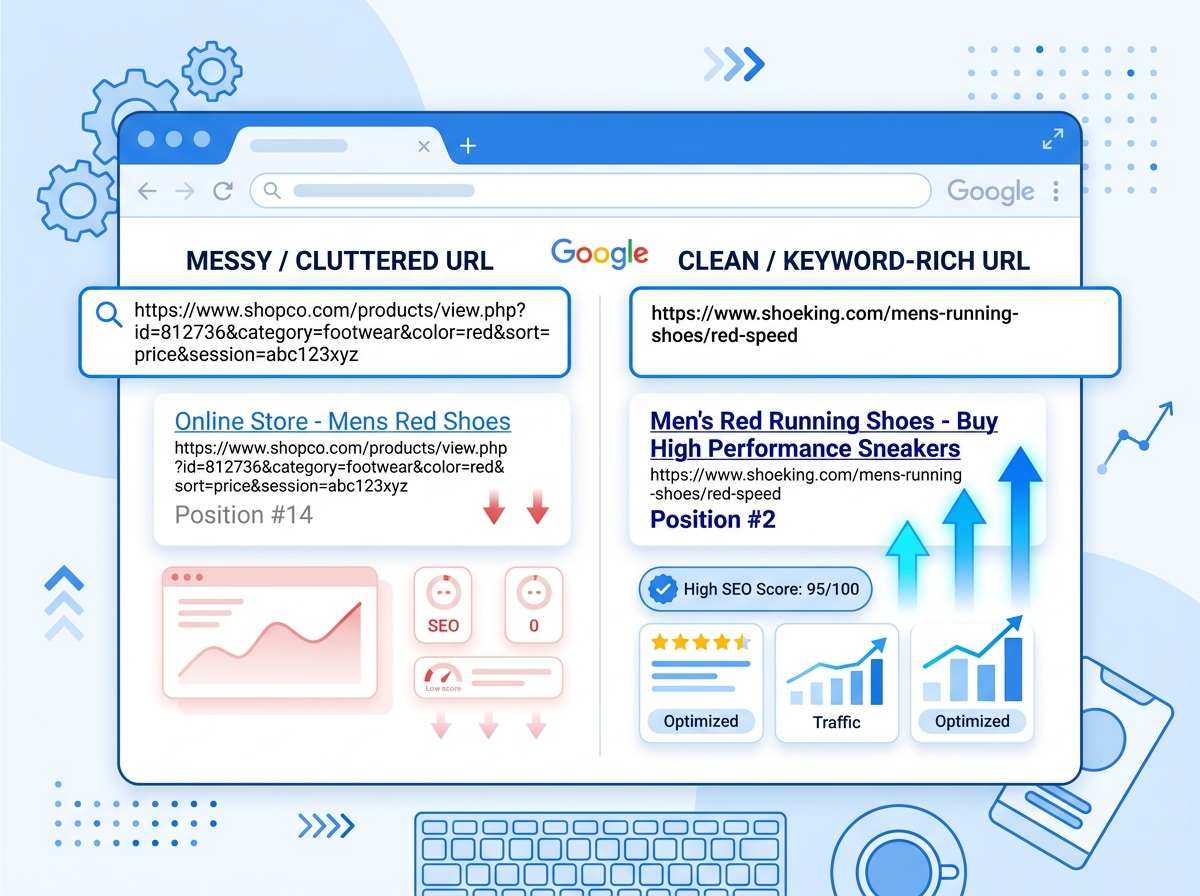
When it comes to ranking higher on Google, most business owners focus on content and backlinks — and rightfully so. But there’s one often-overlooked element that quietly impacts your search performance every single day: your URL structure SEO. Getting your URLs right is one of the simplest, most effective things you can do to improve how search engines crawl your site and how users navigate it. Let’s break down exactly what you need to know heading into 2026.
Why URL Structure Matters More Than You Think
Your URLs are like street addresses for your web pages. If they’re messy, confusing, or full of random characters, both Google and your visitors will have a harder time understanding what your page is about. A clean, logical URL tells search engines exactly what to expect before they even crawl the content.
Think about it this way: which URL would you trust more?
yoursite.com/p=1234?ref=abc vs. yoursite.com/seo-tips-for-small-business
The second one is clear, readable, and keyword-rich. That’s the kind of URL structure that builds trust with both Google and your audience. And in a competitive search landscape, every small advantage counts.
How URLs Affect Click-Through Rates
When your URL appears in search results, it’s visible to users before they even click. A descriptive, clean URL can actually increase your click-through rate because it signals relevance and professionalism. Messy URLs, on the other hand, can look spammy and drive users away — even if your content is excellent.
URLs and Crawl Efficiency
Search engines have a limited crawl budget for every website. If your URLs are bloated with unnecessary parameters or duplicate paths, you’re wasting that budget on pages that don’t matter. A well-organized URL structure helps Google prioritize and index your most important pages faster.
The Core Rules of SEO-Friendly URLs
Whether you’re building a new site or auditing an existing one, these foundational rules will help you create URLs that work harder for your business. These aren’t just technical guidelines — they’re practical habits that make a real difference in your URL structure SEO performance.
Keep It Short and Descriptive
Shorter URLs tend to perform better in search results. Aim to keep your URLs under 75 characters when possible. Include your target keyword, but don’t stuff it — one clear, relevant keyword or phrase is all you need.
- Do:
yoursite.com/social-media-tips - Don’t:
yoursite.com/blog/2024/03/15/top-social-media-tips-for-small-businesses-in-2024
Use Hyphens, Not Underscores
Google treats hyphens as word separators, but underscores are treated as connectors. That means social-media-tips is read as three separate words, while social_media_tips is read as one long word. Always use hyphens to separate words in your slugs.
Use Lowercase Letters Only
URLs are case-sensitive on many servers. Using uppercase letters can create duplicate content issues if both versions of a URL are accessible. Stick to all lowercase to keep things consistent and avoid technical headaches down the road.
Remove Stop Words When Possible
Words like “a,” “the,” “and,” and “of” add length without adding SEO value. For example, instead of /the-best-tips-for-seo, use /best-seo-tips. Cleaner slugs are easier to read and share.
Avoid Dynamic Parameters When You Can
Dynamic URLs with strings like ?id=45&session=abc123 are hard for search engines to parse and look unprofessional to users. If your platform generates these automatically (like some e-commerce or CMS platforms), look into URL rewriting options to create static, readable paths instead.
Structuring Your Site’s URL Hierarchy
Beyond individual page slugs, the overall architecture of your URLs plays a big role in how Google understands your site. A logical hierarchy signals topical authority and helps search engines connect related content — which is a major ranking factor in 2026.
Use a Logical Folder Structure
Organize your URLs to reflect your site’s content categories. This helps both users and search engines understand the relationship between pages. For example:
yoursite.com/seo/— Category pageyoursite.com/seo/url-structure-tips— Blog post under that categoryyoursite.com/seo/keyword-research-guide— Another related post
This kind of structure tells Google that your site has depth and expertise in a specific topic area. It also makes internal linking much more natural and effective. Speaking of which, if you want to go deeper on site architecture, check out our guide on how to build an SEO-friendly site structure.
Avoid Deep Nesting
Try not to bury your pages too deep in your URL structure. Pages that are more than three or four levels deep (e.g., /blog/category/subcategory/post-title) can be harder for Google to crawl and may receive less link equity. Keep your most important pages as close to the root domain as possible.
Canonicalize Duplicate URLs
If the same content is accessible via multiple URLs (with or without trailing slashes, with www vs. without, etc.), use canonical tags to tell Google which version is the “official” one. This prevents duplicate content issues that can dilute your rankings. You can also learn more about this in our post on technical SEO essentials for small businesses.
Common URL Mistakes That Hurt Your Rankings
Even well-intentioned websites make URL mistakes that quietly drag down their SEO. Here are the most common ones to watch out for — and fix if you spot them on your site.
- Using dates in URLs: Dates make content look outdated and create redirect headaches when you update posts. Avoid them unless your content is truly time-sensitive.
- Keyword stuffing in slugs: Cramming multiple keywords into a URL looks spammy and doesn’t help rankings. One focused keyword phrase is enough.
- Changing URLs without redirects: If you update a URL, always set up a 301 redirect from the old URL to the new one. Broken links destroy both user experience and SEO value.
- Inconsistent trailing slashes: Pick one format (with or without a trailing slash) and stick to it across your entire site.
- Auto-generated gibberish slugs: Some platforms default to slugs like
/p=123or/untitled-post-4. Always customize your slugs before publishing.
If you’re running an online store, URL structure becomes even more critical. Check out our tips on e-commerce SEO best practices to make sure your product and category pages are fully optimized.
Key Takeaways
- Clean, descriptive URLs improve both search rankings and user trust — don’t overlook this foundational SEO element.
- Always use hyphens to separate words, lowercase letters, and keep slugs short and keyword-focused.
- A logical URL hierarchy helps Google understand your site’s topical authority and crawl it more efficiently.
- Avoid dynamic parameters, keyword stuffing, and changing URLs without proper 301 redirects in place.
- Audit your existing URLs regularly — fixing structural issues can lead to noticeable ranking improvements without creating new content.
Getting your URL structure SEO right isn’t glamorous work, but it’s the kind of foundational optimization that pays dividends for years. Whether you’re launching a new site or cleaning up an existing one, these best practices will help you build a stronger, more crawlable, and more trustworthy web presence in 2026 and beyond.
Ready to take your SEO strategy to the next level? Our team at LetsGetSocialOnline.com specializes in helping small businesses and entrepreneurs build websites and digital strategies that actually rank. Get in touch with us today and let’s build something great together.