
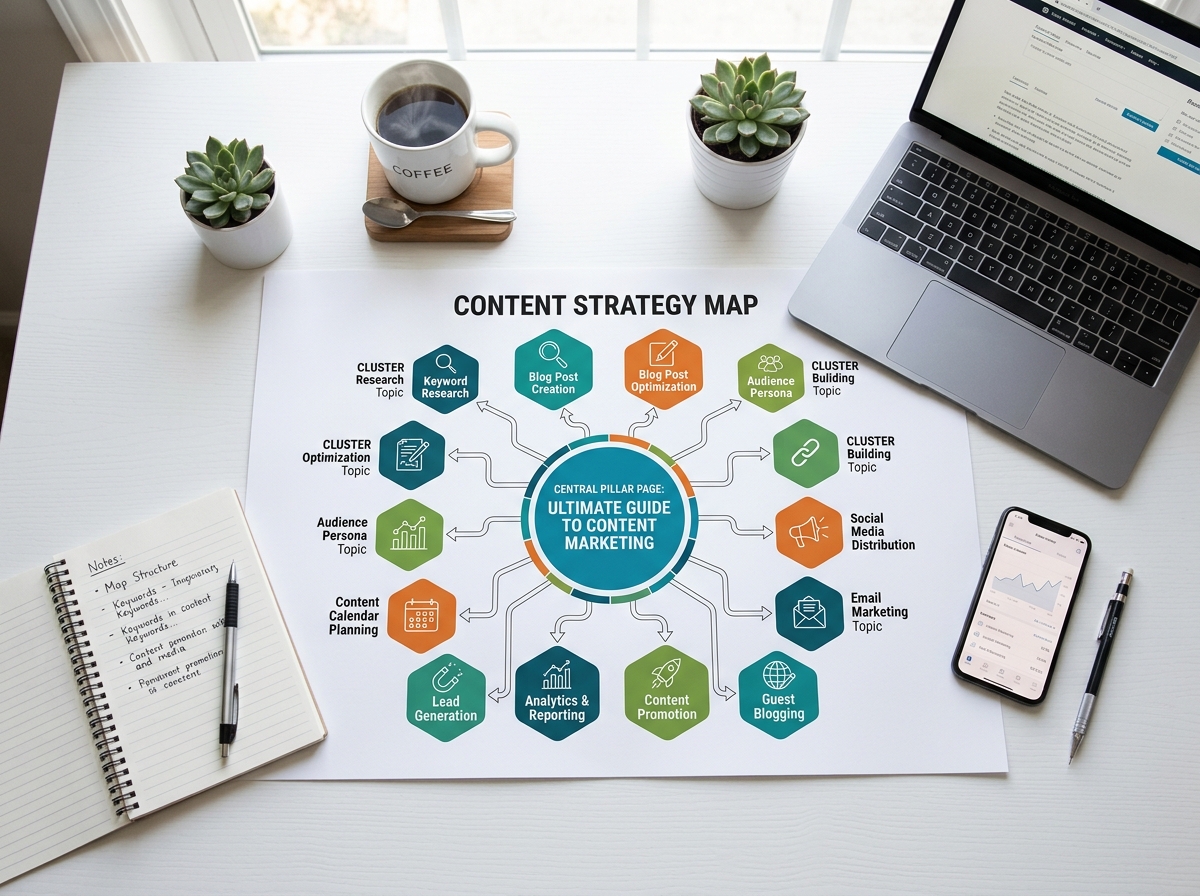
If you’ve been publishing blog posts and still struggling to rank on Google, the problem might not be your writing — it might be your strategy. Topical authority SEO is one of the most powerful (and underused) approaches to getting your website noticed by Google faster. Instead of chasing individual keywords, you build deep, comprehensive coverage of a topic so Google sees your site as the go-to expert. Let’s break down exactly how to do that.
What Is Topical Authority and Why Does It Matter?
Topical authority is Google’s way of measuring how much expertise your website demonstrates on a specific subject. When your site consistently covers a topic from multiple angles — answering beginner questions, diving into advanced strategies, and everything in between — Google starts to trust your content more. That trust translates directly into higher rankings.
Think of it this way: if you walked into a library looking for advice on social media marketing, would you trust a book that covers it in one chapter, or an entire shelf dedicated to the subject? Google thinks the same way. The more thoroughly you cover a topic, the more authority you earn.
This is especially important for small businesses and entrepreneurs competing against larger brands. You may not have the domain authority of a Fortune 500 company, but you can out-niche them by becoming the definitive resource on a focused topic in your industry.
How to Build Topical Authority SEO the Right Way
Start With a Pillar Page
A pillar page is a long-form, comprehensive piece of content that covers a broad topic at a high level. It acts as the hub of your content strategy. For example, if your business focuses on social media marketing, your pillar page might be titled “The Complete Guide to Social Media Marketing for Small Businesses.”
Your pillar page doesn’t need to go 10,000 words deep on every subtopic — that’s what your supporting content is for. Instead, it should give readers a solid overview and link out to more detailed articles on each subtopic. This internal linking structure is what signals topical depth to Google.
Build Out Content Clusters
Content clusters are the supporting blog posts, guides, and articles that link back to your pillar page. Each cluster piece dives deeper into a specific subtopic. Using the social media example, your cluster content might include posts like “How to Create a Content Calendar,” “Instagram vs. Facebook: Which Is Better for Your Business,” or “How to Use AI Tools for Social Media Scheduling.”
The key is that every cluster article links back to your pillar page, and your pillar page links out to each cluster article. This web of internal links tells Google that your site has broad and deep knowledge on the subject — a core signal for topical authority SEO.
Not sure where to start with your content plan? Check out our guide on building an SEO content strategy for your business to map out your topics before you start writing.
Do Thorough Topic Research (Not Just Keyword Research)
Traditional keyword research focuses on search volume and competition. Topical research goes further — it asks, “What does someone need to know to fully understand this subject?” Use tools like Google’s “People Also Ask” section, Answer the Public, or even ChatGPT to brainstorm every question your audience might have around your core topic.
Your goal is to leave no stone unturned. If a potential customer has a question related to your niche, your website should have the answer. Over time, this comprehensive coverage builds the kind of trust that moves you up the search rankings — even for competitive keywords.
Common Mistakes That Hurt Your Topical Authority
- Publishing random content with no theme: If your blog covers five unrelated topics, Google can’t categorize your expertise. Stay focused on your niche.
- Ignoring internal linking: Without links connecting your content, Google can’t see the relationship between your articles. Always link related posts together.
- Writing thin content: Short, surface-level posts don’t demonstrate expertise. Aim for depth and real value in every piece you publish.
- Skipping the pillar page: Without a central hub, your cluster content has nowhere to anchor. Build your pillar page first.
- Inconsistent publishing: Topical authority is built over time. A consistent publishing schedule signals to Google that your site is active and growing.
If you’re also working on your website’s technical foundation, our post on on-page SEO tips for small business websites is a great companion read to this strategy.
How Long Does It Take to See Results?
Building topical authority SEO is a long-term play — but it pays off in a big way. Most businesses start seeing meaningful ranking improvements within three to six months of consistently publishing cluster content. The more focused your niche and the more thoroughly you cover it, the faster Google rewards you.
The good news? Once you’ve established authority in a topic area, it becomes much easier to rank for new keywords within that same niche. You’re essentially building a compounding asset that grows in value over time — unlike paid ads that stop the moment you stop spending.
If you’re using AI tools to speed up your content creation process, that’s a smart move. Just make sure every piece is genuinely helpful and written for your audience first, search engines second. Learn more about how AI tools can support your content marketing strategy without sacrificing quality.
- Topical authority SEO means covering a subject comprehensively so Google sees your site as a trusted expert.
- Start with a strong pillar page, then build out supporting cluster content that links back to it.
- Internal linking is essential — it shows Google the depth and structure of your content strategy.
- Avoid publishing random, unrelated content; stay focused on your niche to build authority faster.
- Results typically appear within three to six months, and the benefits compound over time.
Ready to Build Your Topical Authority Strategy?
Building topical authority SEO takes planning, consistency, and a clear content roadmap — but you don’t have to figure it all out on your own. At LetsGetSocialOnline.com, we help small businesses and entrepreneurs create SEO strategies that actually move the needle. From pillar pages to full content cluster plans, we’ve got you covered.
Let’s build your authority together. Contact our team today and let’s create an SEO content strategy that gets your business ranking faster on Google.