
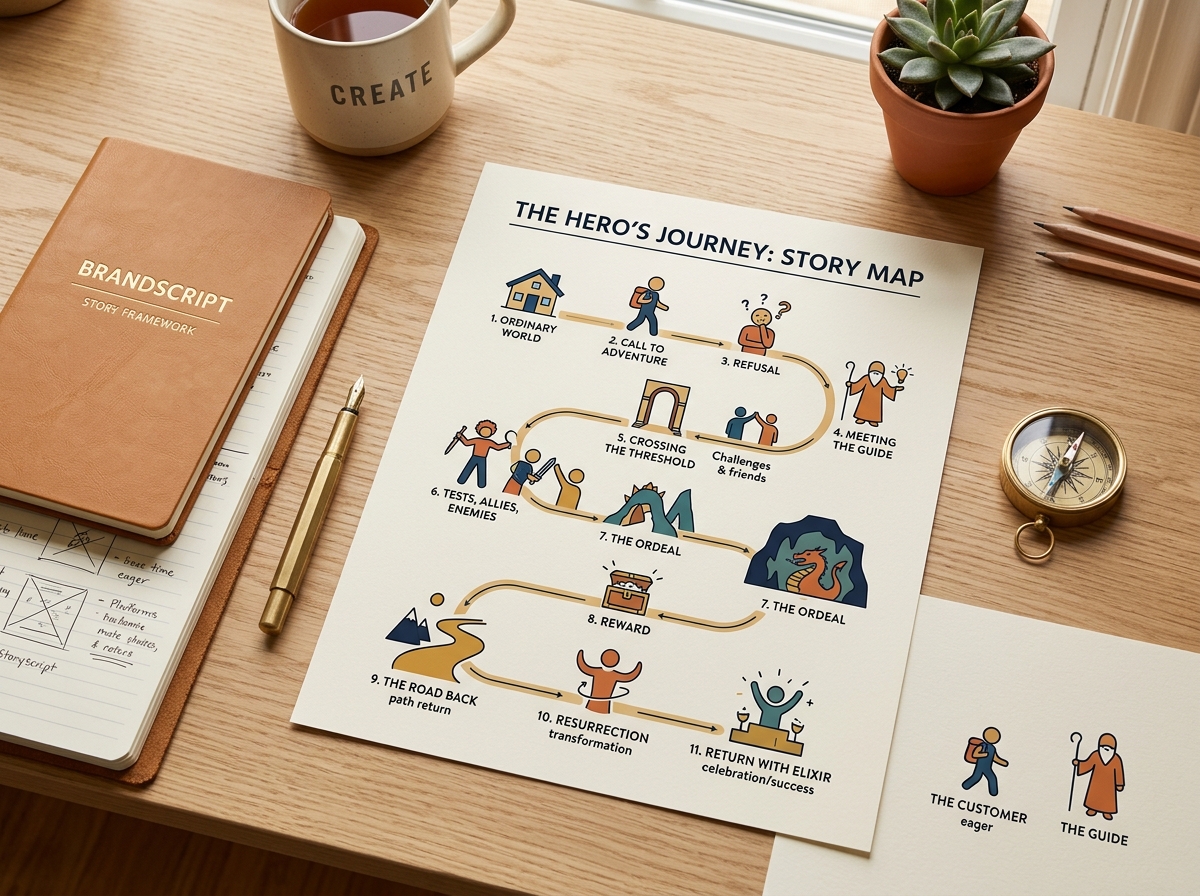
If your website visitors can’t figure out what you do within five seconds of landing on your page, you’re losing customers — fast. That’s exactly the problem the StoryBrand framework marketing approach was designed to solve. Created by Donald Miller, this powerful messaging system helps businesses cut through the noise and communicate their value in a way that actually connects with people. The best part? You can map it all out on a single page.
In this post, we’re breaking down the StoryBrand framework in plain English so you can start applying it to your own marketing today — no agency degree required.
What Is the StoryBrand Framework?
The StoryBrand framework is a 7-part messaging model based on the structure of a classic story. The core idea is simple: your customer is the hero, not your brand. Your business plays the role of the guide — think Yoda to Luke Skywalker, or Gandalf to Frodo. When you position your brand this way, your messaging becomes instantly more relatable and compelling.
Most businesses make the mistake of talking about themselves — their history, their awards, their process. But customers don’t care about any of that until they know you understand their problem and can help them solve it. The StoryBrand framework flips the script and puts the customer’s journey front and center.
The 7 Elements of the StoryBrand Framework
Here’s a quick overview of the seven parts that make up the framework:
- A Character (Your Customer): Who is your ideal customer, and what do they want?
- Has a Problem: What external, internal, and philosophical problems are they facing?
- And Meets a Guide (Your Brand): You show up with empathy and authority.
- Who Gives Them a Plan: A simple, clear path to working with you.
- And Calls Them to Action: A direct call-to-action that tells them exactly what to do next.
- That Helps Them Avoid Failure: What’s at stake if they don’t act?
- And Ends in Success: Paint a picture of the transformation they’ll experience.
When you run your marketing through this lens, every piece of content — from your homepage to your social media bio — becomes clearer and more persuasive.
How to Apply the StoryBrand Framework to Your Marketing
The most practical tool that comes out of the StoryBrand framework is something called a BrandScript. Think of it as a one-page messaging document that captures all seven story elements for your business. Once you have it, you can use it to write your website copy, email campaigns, social media posts, and even your elevator pitch.
You don’t need fancy software to create one. A simple Google Doc or even a printed worksheet will do the job. The goal is to get your messaging out of your head and onto paper so your entire team (or just you, if you’re a solopreneur) is speaking the same language.
Start With the Problem, Not the Product
One of the biggest shifts the StoryBrand framework marketing approach encourages is leading with your customer’s problem instead of your product features. Before you talk about what you offer, acknowledge what your customer is struggling with. This immediately signals that you “get it” — and that builds trust faster than any testimonial.
For example, instead of saying “We offer professional web design services,” try: “Tired of a website that doesn’t bring in leads? We build sites that actually convert.” See the difference? The second version speaks directly to a pain point your customer already feels.
Make Your Call-to-Action Crystal Clear
The StoryBrand framework emphasizes having a direct call-to-action — one clear next step you want your visitor to take. This could be “Book a Free Call,” “Download the Guide,” or “Get Started Today.” Avoid vague phrases like “Learn More” or “Click Here.” Clarity drives action.
If you’re not sure whether your current website messaging is working, check out our guide on building a high-converting website to see how design and copy work together to turn visitors into leads.
Why This Framework Works So Well for Small Businesses
Small business owners often wear every hat — marketer, salesperson, customer service rep, and CEO. You don’t have time to overthink your messaging. The StoryBrand framework gives you a repeatable system that removes the guesswork. Once your BrandScript is done, creating content becomes dramatically easier because you always know what to say and how to say it.
It also works across every marketing channel. Whether you’re writing a Facebook ad, updating your LinkedIn bio, or crafting an email sequence, the same core message applies. Consistency builds recognition, and recognition builds trust.
Pair It With the Right Digital Tools
Once your messaging is clear, the next step is making sure it’s showing up in the right places. That means optimizing your website for SEO, showing up consistently on social media, and automating your follow-up so no lead falls through the cracks. Our social media management services can help you turn your StoryBrand message into content that actually reaches your audience.
You might also want to explore how marketing automation with Make.com can help you deliver the right message to the right person at the right time — without adding more to your plate.
Putting It All Together
The beauty of the StoryBrand framework marketing approach is that it’s not just a theory — it’s a practical tool you can use right now. You don’t need a big budget or a marketing team. You just need clarity about who your customer is, what problem you solve, and how you guide them to a better outcome.
Start by writing out your BrandScript today. Even a rough first draft will give you more messaging clarity than most businesses ever achieve. Then use it to rewrite your homepage headline, update your social media bio, and sharpen your next email campaign. Small changes in how you communicate can lead to big changes in how many people say yes.
Key Takeaways
- The StoryBrand framework positions your customer as the hero and your brand as the guide.
- A BrandScript is a one-page messaging tool that captures all 7 story elements for your business.
- Lead with your customer’s problem before talking about your product or service.
- Use a clear, direct call-to-action on every page and in every campaign.
- Your StoryBrand message should be consistent across your website, social media, and email marketing.
Ready to clarify your marketing message and start attracting more of the right customers? Let’s build your brand story together. Contact our team at LetsGetSocialOnline.com and let’s get started.